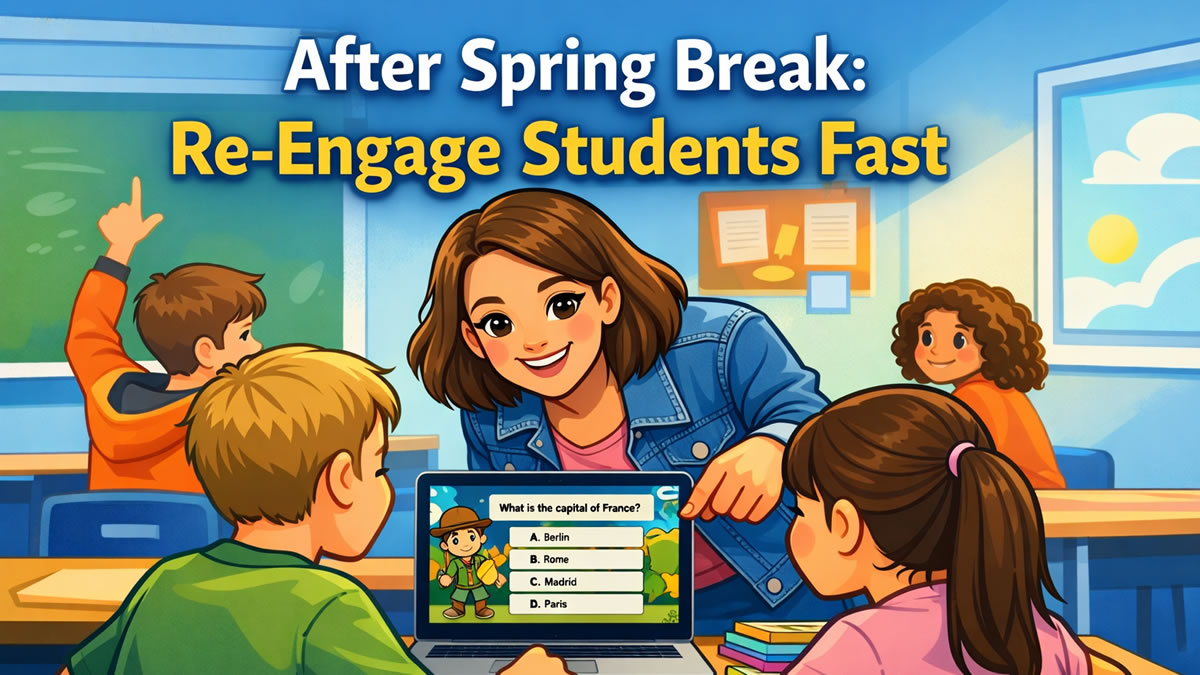
The first days back from Spring Break can feel uneven. Some students return energized. Others come back distracted, rusty, or mentally still on vacation. Teachers often feel pressure to jump straight into new content, but when routines and attention need a reset, that can make the transition harder than it needs to be.
That is why the week after break works better as a re-entry week, not just a return week.
With BrainFusion, you can use short, game-based review to help students reconnect with classroom expectations, refresh important concepts, and build momentum without turning the first few days back into a struggle. Instead of planning a large review packet or a high-pressure quiz, you can create a fast, low-stakes game from your notes, standards, or old assessments and use the results to decide what students actually need next.
Why the Week After Spring Break Matters
A long break can interrupt more than content coverage. It can disrupt:
- classroom routines
- attention stamina
- recall of recently learned material
- confidence for students who were already feeling behind
Research on learning and memory suggests that students retain more when they have opportunities to retrieve what they learned, revisit it over time, and receive feedback on what they got right and wrong. That makes the first week back a strong moment for short review experiences that reactivate prior knowledge instead of asking students to sit through passive re-teaching.
A brief BrainFusion review game can help make that happen. Students get a chance to recall important ideas, notice what they forgot, and get immediate feedback in a lower-pressure format. Teachers get quick information about which concepts feel solid, which ones need a refresh, and where a full reteach is actually necessary.
💡 Pro Tip
Do not treat the first day back as a test day. Use a 10–15 minute BrainFusion game as a memory warm-up so students can rebuild confidence before you move into new content.
A Simple Post-Break BrainFusion Plan
You do not need a full unit redesign to make the week after Spring Break smoother. A simple three-part plan works well in most classrooms.
1. Start with a low-stakes reset game
On the first day back, build a short BrainFusion game with 8 to 15 questions from material students learned before the break. Focus on essential ideas, not tiny details.
Good prompts might include:
- “Create a 10-question review game on fractions for 5th grade.”
- “Build a middle school science review on the water cycle and weathering.”
- “Generate a high school ELA game reviewing theme, tone, and text evidence.”
Keep the tone light. The goal is not to grade students harshly. The goal is to get their brains working again.
This first game helps you:
- reactivate prior knowledge
- rebuild classroom energy
- lower the stress of returning
- gather fast diagnostic information
2. Use the results to group your next steps
After the game, look at the question-level results. Which concepts did most students miss? Which standards seem solid? Which errors look like break-related forgetting versus deeper misunderstanding?
This is one of BrainFusion’s biggest practical advantages. Instead of planning blindly, you can sort concepts into three buckets:
- Ready to move on — most students answered correctly
- Needs a quick refresh — students are rusty but close
- Needs reteaching — misconceptions are showing up clearly
That makes the rest of the week easier to plan.
3. Replay the same content in a different mode
Students often need more than one pass, but they do not need the exact same experience every time. One smart workflow is to create a question set once and then reuse it in different ways.
For example:
- Use Quiz Quest for your first-day whole-class review
- Use Artifact Adventure the next day for a more exploratory feel
- Use Ninja Fruit Frenzy for a quick energy boost later in the week
- Use Flashcard Fusion for independent reinforcement or station work
This kind of variation matters. Research on spacing and interleaving suggests that learning improves when students revisit content over time and across mixed practice, rather than doing one large block of review and moving on.
Four Smart Ways to Use BrainFusion After Spring Break
1. Rebuild routines with bell-ringer games
The first five minutes after break matter more than usual. Students are relearning how your class starts, where to focus, and what productive attention feels like.
A short BrainFusion bell-ringer can reset the tone fast.
Try this structure:
- 5 questions
- 5 minutes
- one key skill from before the break
- one quick discussion question after the game
Examples:
- Math: solving one-step equations
- Science: lab safety or vocabulary review
- Social studies: causes and effects from the last unit
- ELA: grammar review or literary terms
This works especially well because routines reduce friction. When students know how class begins and what success looks like, they can spend less energy figuring out the structure and more energy focusing on learning.
2. Turn review into a confidence builder
Some students return from break worried that they forgot everything. A game-based review gives them a safer way to re-enter.
Instead of saying, “Take out your notebook and write down everything you remember,” you can launch a BrainFusion game and let retrieval happen through play. Immediate feedback helps students correct mistakes in the moment, and the lower-stakes format can make participation feel more manageable.
A helpful rule: start with easier questions first, then mix in more challenging ones. Early success can rebuild confidence and improve participation for the rest of the session.
3. Use interleaved review before introducing new content
The week after break is a great time to reconnect multiple ideas students have learned over time. Rather than reviewing only the most recent lesson, mix a few related concepts together.
For example:
- a math teacher could combine fractions, decimals, and percentages
- a science teacher could mix vocabulary, diagrams, and application questions
- an ELA teacher could review plot, inference, and evidence in the same game
Mixed review helps students do more than remember isolated facts. It asks them to decide which idea or strategy applies, which is often closer to the kind of thinking they need in real assignments and assessments. For more on building this into your weekly routines, see Effortless Spiral Review Routines for Every Classroom.
4. Plan small-group support from the data
Not every student needs the same kind of reset after break. Some are ready immediately. Others need a softer landing.
BrainFusion makes it easier to spot patterns:
- a group that needs vocabulary reinforcement
- a group that struggles with application questions
- a few students who need one-on-one support on a specific skill
That means your follow-up can stay targeted instead of becoming a full-class reteach for everyone.
🎮 BrainFusion Move to Try This Week
Paste last month’s study guide or notes into BrainFusion, generate a short review game, then use the results to decide whether your class is ready for new material or needs one more day of targeted refresh.
Create Your First Game Free →Best Practices for Post-Break Success
The best post-break activities are simple, structured, and low-pressure.
Best Practices:
- Keep first-day games short and winnable
- Review priority concepts before minor details
- Use game data to guide the rest of the week
- Rotate modes to keep practice fresh
- Build in a quick class debrief after each game
Common Mistakes to Avoid:
- ❌ Starting with a major graded assessment right away
- ❌ Trying to review everything from the entire semester in one session
- ❌ Assuming low energy means students do not care
- ❌ Ignoring the data and teaching the week exactly as originally planned
- ❌ Making re-entry activities so long that students lose momentum
The sweet spot is usually a series of short, focused experiences rather than one giant review block. For more ideas, see How to Turn Review Days Into Something Students Look Forward To.
A Realistic 3-Day Example
Here is what a practical post-Spring Break BrainFusion sequence could look like in a middle school classroom.
Day 1: Re-entry review
The teacher pastes key concepts from the pre-break unit into BrainFusion and launches a 10-question game. Students play for 10 to 12 minutes, then discuss the two most-missed questions.
Goal: rebuild confidence and collect fast data.
Day 2: Targeted refresh
Using the previous day’s results, the teacher creates a second game focused only on the concepts students missed most often. This time, students play in pairs and explain their thinking after each round.
Goal: strengthen weak spots without reteaching the whole unit.
Day 3: Bridge to new learning
The teacher mixes two review concepts with the first ideas from the new unit in an interleaved game. Students see that old learning still matters, and the transition into new content feels smoother.
Goal: connect review to what comes next.
That sequence keeps the week moving while still honoring the reality that students are returning from time away.
Why BrainFusion Fits This Moment So Well
Post-break teaching is all about balance. You want energy, but you also want structure. You want review, but you do not want boredom. You want data, but you do not want to spend hours building assessments.
BrainFusion fits this moment because it gives teachers a practical way to:
- create games quickly from existing content
- give students an active way to restart learning
- gather useful insight without adding a lot of prep
That combination is especially valuable after a break, when time, attention, and momentum all matter.
Start Small, Then Build the Week
You do not need a perfect Spring Break comeback plan. You just need a strong first step.
Start with one short BrainFusion game built from the most important concepts students learned before the break. Let students experience a quick success. Review the results. Then use that information to shape the next few days.
A thoughtful reset can do more than review content. It can restore rhythm, confidence, and focus.
Turn the First Week Back Into a Win
Create a fast BrainFusion review game to help students reconnect, rebuild confidence, and get ready for what comes next.
Sources
- Retrieval Practice — The Learning Scientists
- Retrieval Practice: How to Encourage Long-Term Retention — The Learning Scientists
- Feedback and Metacognition — RetrievalPractice.org
- Organizing Instruction and Study to Improve Student Learning — Institute of Education Sciences
- Cognitive Science Approaches in the Classroom: A Review of the Evidence — Education Endowment Foundation
- Teacher Feedback to Improve Pupil Learning — Education Endowment Foundation
- How Do You Re-engage Students After School Breaks? — Edutopia
- How to Establish Classroom Routines for Productive Learning — Edutopia
- Student Engagement as an Aspect of Classroom Management — Edutopia