Self-study sounds empowering in theory.
In practice, it can feel like wandering through a huge map with no guide, no checkpoints, and no clear sense of whether you're making real progress. One day you're motivated. The next day you're staring at notes, flashcards, or a half-finished online course wondering where to start.
That’s why personalized learning matters so much for independent learners.
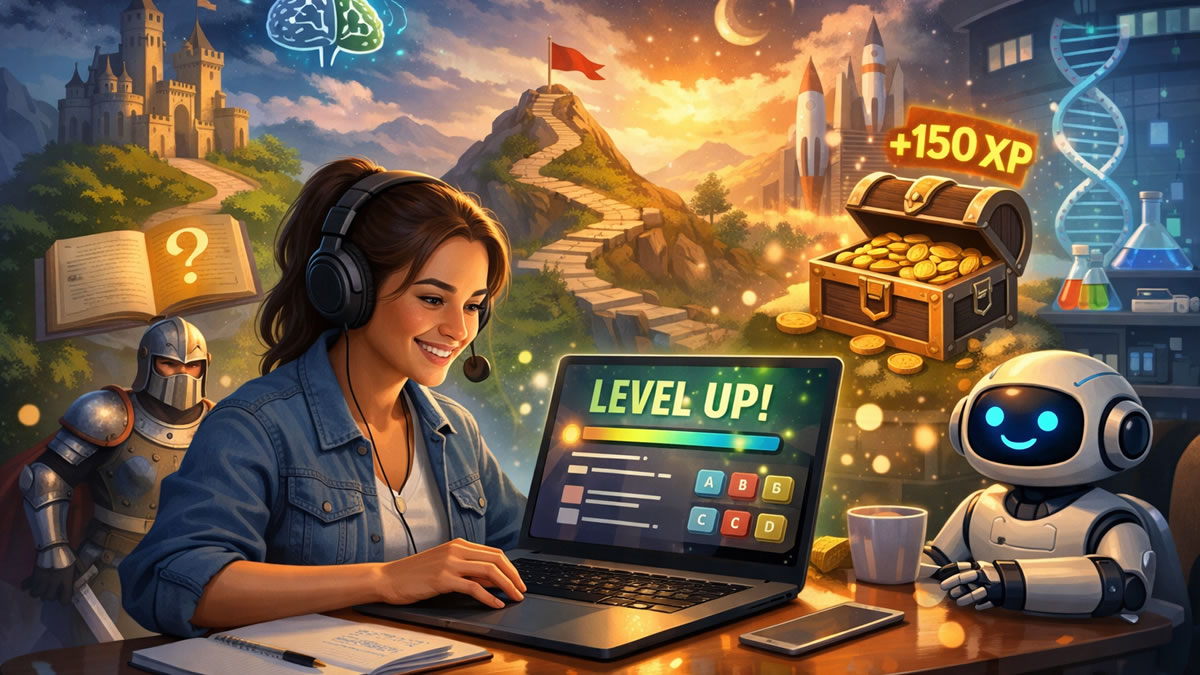
When AI-powered educational games adapt to your level, pace, and goals, studying stops feeling like repetition for its own sake. It starts to feel like a learning adventure—one where each challenge is designed for the stage you’re actually in, not the stage someone else assumes you should be in.
For college students, certification candidates, language learners, and working professionals building new skills, this shift is powerful. Instead of moving through static practice sets, you can work through a more responsive experience that adjusts difficulty, reinforces weak spots, and keeps momentum going.
BrainFusion Games was built around that idea: turn practice into play, while using learning science like retrieval practice, spaced repetition, interleaving, and immediate feedback to help knowledge stick. You can try it free with your own content.
Why Self-Directed Learners Need Personalization
Classrooms and workplace training programs usually come with structure. A teacher sets the sequence. A trainer chooses the pace. A curriculum defines the checkpoints.
Independent learners often do not have that support.
You might be studying:
- Biology before a big exam
- Accounting concepts for a certification
- Medical terminology for work
- Spanish verbs for travel or class
- Product knowledge for a new role
In every case, the challenge is the same: how do you know what to study next?
Too many self-study tools still rely on one-size-fits-all practice. They deliver the same question order, the same level of difficulty, and the same review pattern to every learner. That creates three common problems:
- Easy material takes too much time because you keep reviewing what you already know
- Hard material feels discouraging because the jump in difficulty is too steep
- Motivation drops because practice feels repetitive instead of rewarding
Personalized AI games can help solve all three.
Instead of treating every learner the same, adaptive systems can respond to performance over time. If you answer several questions correctly in a row, the next challenge can become more complex. If you struggle with a concept, the game can bring you more review, smaller steps, or another angle on the same idea.
That matters because effective self-study is not just about effort. It is about spending effort in the right places.
💡 Pro Tip
The best personalized study tools do not just make learning feel fun. They help you decide what deserves more attention today, so your limited study time goes further.
What an AI-Driven “Learning Adventure” Looks Like
Think of a personalized learning adventure as a study experience with progression.
You begin with a starting point—your current level, your content, and your goal. From there, the system helps shape the path forward.
1. It starts at your level
A college student reviewing psychology should not get the exact same sequence as a classmate who already knows the chapter well. A professional preparing for a certification exam should not waste energy on basics they mastered last month.
An AI-powered game can begin with a quick set of diagnostic questions or a simple practice round to estimate where you are.
For example:
- If you miss foundational vocabulary, the game shifts toward core definitions
- If you show strong recall, it moves into scenarios, applications, or mixed-topic review
- If your performance is uneven, it alternates easier confidence-building items with more challenging questions
That creates a better entry point and reduces the frustration that often causes self-study plans to collapse.
2. It adapts as you play
This is where the “adventure” feeling becomes more real.
Imagine you are studying project management terms. In your first round, you answer basic definitions correctly. The next round gives you short workplace scenarios. Then the game asks you to compare similar concepts that are easy to confuse.
Or imagine you are learning anatomy. You struggle with one body system but do well in another. A static quiz would simply score you and move on. An adaptive game can keep resurfacing your weak area while letting your stronger area appear less often.
That balance matters. You keep moving forward, but the system does not forget what still needs work.
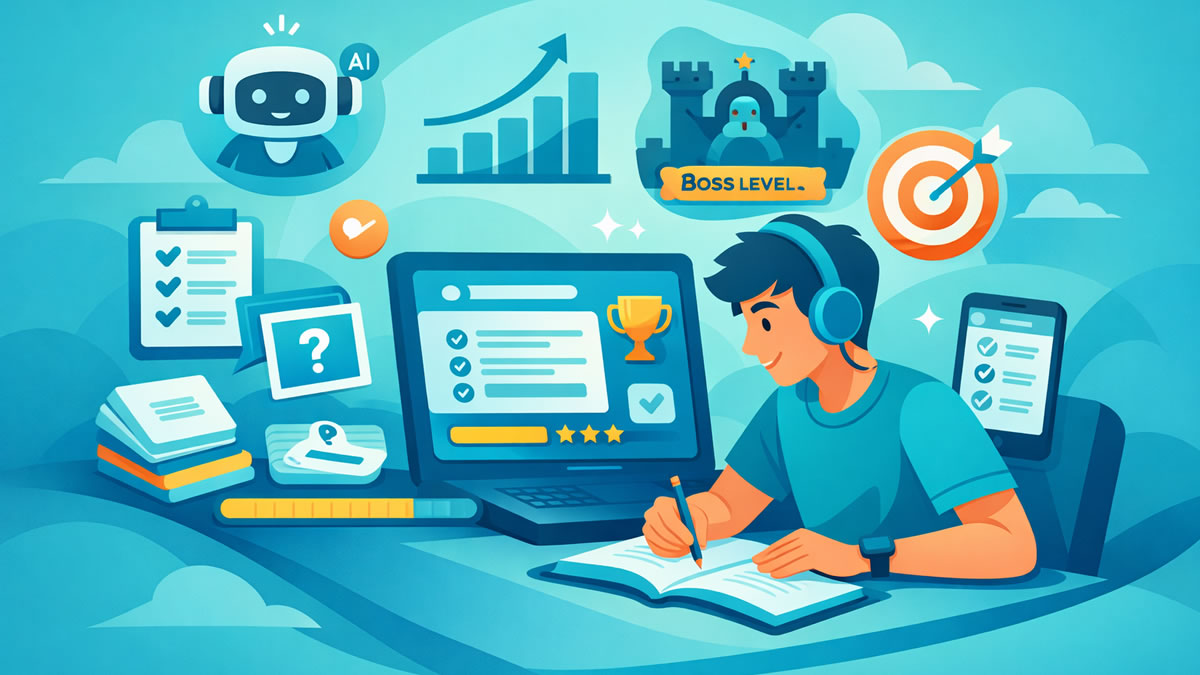
3. It turns progress into visible milestones
Self-study is easier when progress is visible.
A good learning game can turn practice into:
- levels
- streaks
- progress bars
- unlockable review sets
- topic “boss battles”
- mastery zones
(For more gamification ideas, see our guide on gamifying your study routine with AI tools.)
These mechanics are not just decoration. They help learners feel momentum. And momentum is often the difference between a study routine that lasts three days and one that lasts three months.
How AI Games Can Personalize Practice in Real Terms
“Personalized” can sound vague, so let’s make it concrete.
Here are a few ways an AI-powered educational game might adapt to an independent learner’s needs.
Adjusting difficulty
Suppose you are studying finance.
- Early questions ask for basic term recognition
- Later questions ask you to interpret a balance sheet
- If you struggle, the system returns to simpler examples before increasing complexity again
The result is a smoother climb instead of a cliff.
Changing question types
If you keep succeeding with multiple-choice questions, the next step might be:
- short-answer recall
- matching concepts
- scenario-based application
- mixed-topic challenge rounds
This helps prevent “recognition without mastery,” where something looks familiar but is still hard to produce from memory.
Revisiting weak spots on purpose
A personalized game should not only reward what you know. It should help repair what you don’t.
If you repeatedly miss a concept, the game can:
- bring it back sooner
- reword it differently
- pair it with a simpler example
- mix it into later rounds until accuracy improves
That makes review strategic rather than random.
Matching pace to energy and time
Not every learner has an hour to study.
Some days you need a 7-minute sprint between classes. Other days you want a deeper 30-minute session. Personalized learning adventures work better when they support both quick wins and longer runs.
That is one reason game-based practice works well for self-study. It can fit into real life instead of requiring the perfect study environment.
🎮 Why BrainFusion Fits This Approach
BrainFusion Games supports multiple game modes from one content set, along with question-level insights, fast AI-assisted creation, and learning-science-informed practice. That makes it useful not just for classrooms, but also for independent learners building their own study systems. See pricing →
Create a game free →A Simple Framework for Building Your Own Learning Adventure
You do not need a massive curriculum map to make personalized self-study work. Start with a lightweight structure.
Step 1: Choose one clear mission
Good learning adventures begin with a specific goal.
Examples:
- Pass Unit 3 biology exam
- Master 50 cybersecurity terms
- Review Spanish present-tense verbs
- Prepare for a nursing terminology quiz
- Practice customer service scenarios before onboarding
Specific goals make it easier for AI tools to generate focused questions and better progression.
Step 2: Break the mission into zones
Think like a game designer for a minute.
Create 3-5 “zones” or stages, such as:
- Zone 1: Foundations
- Zone 2: Core vocabulary
- Zone 3: Application
- Zone 4: Mixed review
- Zone 5: Final challenge
This turns a vague study plan into a sequence you can actually follow.
Step 3: Use short rounds with feedback
Instead of one giant study session, use smaller loops:
- 10 to 15 questions
- immediate feedback
- quick review of missed items
- one retry or follow-up round
This structure works especially well because it combines retrieval practice with immediate correction—two of the strongest tools for retention.
Step 4: Level up only when accuracy improves
Do not move forward just because time passed.
Move forward when your performance shows readiness. A simple rule works well:
- under 60% = review fundamentals
- 60% to 80% = stay in the zone with more varied questions
- above 80% = advance to a harder level or mixed challenge round
That keeps the experience adaptive without making it complicated.
Step 5: End with a “boss battle”
A boss battle is a cumulative review round.
Mix older material with newer material. Use tougher questions. Add time pressure only if it helps you focus rather than panic. The point is to test transfer, not just repetition.
For self-directed learners, this creates a satisfying checkpoint and shows whether practice is actually working.
Example: A Personalized Quest for a Busy College Student
Let’s say Maya is a college student studying for a microbiology exam.
She has notes, a study guide, and limited time between classes and work shifts.
Here is how a personalized learning adventure could look:
Week 1: Build the map
Maya uses her chapter notes to create an AI-generated practice game.
Her first rounds reveal:
- strong understanding of terminology
- weaker recall on cell structures
- confusion around process sequencing
Instead of reviewing the whole chapter equally, she now knows where to focus.
Week 2: Adaptive practice
Her game sessions start changing:
- easy vocabulary appears less often
- cell structure questions return more frequently
- sequencing questions become scenario-based instead of purely definitional
She is not just repeating content. She is training the parts that still need reinforcement.
Week 3: Mixed review and confidence
Now the game starts mixing old and new concepts together.
This is important because exam questions rarely appear in neat chapter order. Interleaving helps learners practice choosing the right idea at the right time. (For more on this technique, see our guide on interleaving practice in games.)
By the end of the week, Maya can see which concepts still break her streak and which ones have become automatic.
That is what personalization should do: reduce wasted effort, reveal blind spots, and build confidence through targeted progress.
Best Practices for Self-Study With AI Games
The most effective learners usually do a few things consistently.
Best Practices:
- Start with a narrow topic before building larger review sets
- Mix easy wins with stretch challenges to maintain momentum
- Review missed questions right away instead of skipping ahead
- Revisit older topics through mixed practice, not just new content
- Use analytics or score patterns to guide what you study next
Common Mistakes to Avoid:
- ❌ Using only one question type for every session
- ❌ Confusing high scores with deep understanding
- ❌ Making study sessions too long to sustain consistently
- ❌ Ignoring weak areas because they feel uncomfortable
- ❌ Treating gamification as entertainment only, without reflection or review
The goal is not to make studying flashy. The goal is to make it more intentional, more motivating, and more responsive.
Take Control of Your Learning Journey
Independent learning works best when the path adjusts to the learner—not the other way around.
That is why AI-driven educational games are such a promising fit for self-study. They can personalize challenge, pace, review, and progression in ways that make practice feel less like a chore and more like a guided quest.
For college students, professionals, and lifelong learners, that means a better way to study: one that supports motivation while still doing the serious work of building memory and understanding.
If your current study routine feels flat, the answer may not be “work harder.” It may be “study smarter, with a system that adapts.”
Turn Your Next Study Session Into a Game
Create a personalized BrainFusion game from your notes, topic list, or study guide and start practicing with more momentum.