If you teach long enough, you’ve seen this moment: a student clearly understands more than their worksheet suggests, but staying focused through a traditional review activity feels like climbing a hill in wet shoes.
For many students with ADHD or other attention challenges, the issue is not ability. It is often the learning environment, the pacing, the amount of passive seatwork, or the lack of timely feedback and manageable task design. Classroom guidance from the CDC, the American Academy of Pediatrics, and teacher support organizations like Understood all point toward supports like shorter tasks, clear directions, structured routines, breaks, and immediate feedback.
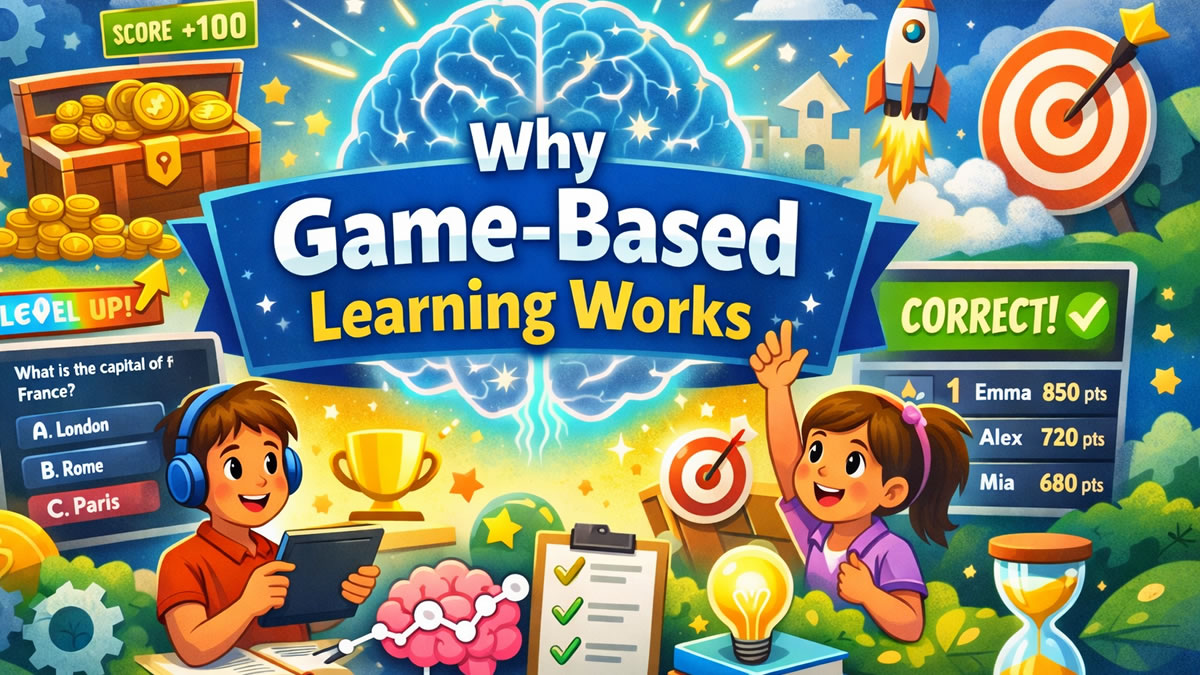
That is one reason game-based learning can be such a helpful classroom tool. When used thoughtfully, games can provide structure, short feedback loops, visible goals, and quick chances to reset and re-engage. At the same time, the research base is still developing: newer studies on game-based interventions for ADHD are promising, but results are not universal across every outcome or every learner. A 2025 systematic review and meta-analysis found encouraging cognitive effects in some areas, while also noting limited evidence for broader behavioral improvement.
This does not mean every student with ADHD will love every game, or that games replace explicit instruction, accommodations, or strong classroom routines. But it does mean game-based learning can become a practical part of a more supportive, more responsive classroom.
Why Game-Based Learning Can Help Students With ADHD
Students with ADHD often do better when learning activities are:
- Short and clearly chunked
- Interactive instead of passive
- Rich with immediate feedback
- Structured around visible goals
- Designed with frequent opportunities to reset and re-engage
That aligns well with what effective game-based learning can offer.
A well-designed learning game breaks a big task into smaller actions. Instead of “complete this full page of review questions,” the experience becomes “answer one question,” “earn progress,” “try again,” or “move to the next round.” That shift matters. It can lower the emotional barrier to starting, reduce the feeling of overwhelm, and help students stay connected to the task. Guidance for ADHD-friendly instruction consistently emphasizes shorter assignments and breaks, chunked directions, and structured, predictable environments.
BrainFusion is especially well suited to this kind of classroom use because it lets teachers create short games quickly, rotate across multiple game modes, and review question-level insights afterward. That means you can keep practice fresh without creating an entirely new activity every day. You can create your first game free in about two minutes.
💡 Important Reminder
Game-based learning is not a “fix” for ADHD. It is one supportive strategy that can improve access, motivation, and participation when paired with clear teaching, predictable routines, and appropriate accommodations.
5 Ways to Use Game-Based Learning for Students With ADHD
1. Keep games short enough to feel winnable
Long review blocks can drain attention fast. Short games often work better because they create a finish line students can actually see.
Try these time frames:
- 3-5 minute warm-up games
- 8-10 minute review rounds
- 1-topic mini games instead of 20-topic mega quizzes
For students with attention challenges, “We’re doing a quick 6-question round” usually feels more manageable than “We’re reviewing for the whole class period.” Short bursts reduce fatigue and make it easier for students to recover if they lose focus for a moment. That design choice also lines up with broader gamification research suggesting that shorter gamified interventions often show stronger effects than longer ones.
What this looks like in practice:
Use a BrainFusion game as a bell ringer with 5-8 questions on yesterday’s lesson. End while energy is still high. Save the deeper reteach for after you’ve seen what students missed.
2. Use immediate feedback to keep students anchored
Many students with ADHD benefit from fast feedback because it closes the gap between effort and response. Waiting until later to learn whether an answer was right can weaken attention and motivation.
Games help because they provide:
- Instant right/wrong signals
- Clear progress markers
- Quick chances to correct mistakes
- A reason to stay engaged through the next question
That feedback loop can be especially powerful during review, when students are still forming confidence. A student who misses question 2 but rebounds on question 3 is still in the game—literally and emotionally. More broadly, feedback is one of the most consistently supported high-impact teaching practices, especially when it is specific and tied to the task. See the EEF’s evidence summary on feedback. ADHD-specific classroom guidance also recommends feedback that is immediate, calm, and concise.
Teacher move:
After each short game, review the top 2-3 missed questions with the class. Keep the correction discussion calm and specific: “What clue helped us know this answer?” That turns errors into learning instead of embarrassment.
3. Rotate formats to refresh attention without changing the learning goal
Novelty helps attention, but too much novelty can become distracting. The sweet spot is changing the format while keeping the academic target consistent.
For example, you might review the same science vocabulary across three different formats during the week:
- Monday: fast-paced multiplayer quiz
- Wednesday: flashcard-style spaced review (see interleaving practice)
- Friday: team-based challenge or movement station game
The content stays familiar, but the experience feels new enough to invite attention again.
This is one of the biggest benefits of BrainFusion’s “create once, play many ways” approach. You can keep the same question set and switch the mode, rather than rebuilding the activity from scratch every time. And while no single study should be treated as definitive, newer research continues to suggest that well-designed gamified learning tools may support attention and academic performance for some students with ADHD. For example, a 2025 randomized controlled trial reported improved attention and academic performance after an 8-week gamified educational intervention compared with a matched non-gamified program.
4. Build in low-stakes success early
Students with ADHD often experience more correction than praise across a school day. Starting with a game can create an early success moment that changes the tone of the lesson.
A few ways to do this:
- Begin with 2 easier retrieval questions before raising difficulty
- Use team play to reduce performance pressure
- Let students replay short practice rounds
- Celebrate progress, not just leaderboard placement
When students feel successful quickly, they are more likely to persist. That does not mean every game should be easy. It means the entry point should feel achievable.
🎮 Practical BrainFusion Idea
Create a 7-question “quick win” game before a quiz. Start with two confidence-building questions, mix in three grade-level questions, and finish with two review items students have seen before. The goal is momentum, not pressure.
Get Started Free →5. Use the data to support, not label
Students with ADHD do not need more proof that attention can be inconsistent. What they do need is instruction that responds to patterns without turning every missed answer into a personal flaw.
Game analytics can help you spot:
- Which concepts break down most often
- Whether errors come from speed, vocabulary, or misunderstanding
- Which students may need shorter chunks or more guided practice
- Whether a student performs better in team mode or solo mode
That lets you plan the next step more precisely. Maybe the issue is not the standard itself. Maybe the student needs fewer items per round, more visual cues, or another low-stakes exposure tomorrow.
Use the information to adjust the environment and the instructional design—not to make assumptions about effort.
Best Practices for ADHD-Friendly Learning Games
Game-based learning is most effective when it is intentionally designed. Here are a few guidelines that matter.
Best Practices:
- Keep directions visible and simple
- Limit unnecessary visual clutter
- Use short rounds with clear stopping points
- Mix individual and collaborative play
- Offer repeat opportunities instead of one-and-done practice
- Preview the goal before the game starts
- Follow the game with a short reflection or reteach moment
These choices line up with common ADHD supports such as shorter, clearer assignments and planned breaks and chunked directions and visible time limits.
A simple routine that works
A reliable pattern helps many students with attention challenges:
1. Preview — “We’re reviewing main idea with 6 questions.”
2. Play — Short round, low-stakes, immediate feedback.
3. Debrief — Review 2-3 common misses.
4. Repractice — Try a second short round or exit ticket.
This rhythm keeps the activity from becoming “just a game.” It turns engagement into usable learning.
Common Mistakes to Avoid
Even good tools can miss the mark if the design is off.
❌ Mistake 1: Making the game too long
Attention fades when the round feels endless. Shorter is usually better.
❌ Mistake 2: Letting competition overshadow learning
Some students are energized by leaderboards. Others shut down. Use team play, personal bests, or replay options when needed.
❌ Mistake 3: Using too many bells and whistles at once
Students with ADHD may be especially sensitive to overstimulation. Keep visuals, sounds, and directions clean.
❌ Mistake 4: Skipping the follow-up discussion
The learning does not end when the game ends. Review misconceptions while they are still fresh.
❌ Mistake 5: Assuming one format works for every learner
Some students focus better in fast-paced modes. Others do better with flashcards, turn-taking, or partner support. Stay flexible.
Sample Classroom Uses by Subject
Here are a few realistic ways teachers can apply this approach.
ELA: Reading comprehension check
After a short passage, launch a 5-question game on main idea, inference, and vocabulary in context. Keep the round under 7 minutes. Then review the two most-missed questions together.
Math: Retrieval warm-up
Start class with a 6-question mixed review game covering yesterday’s skill plus two older standards. This keeps practice brief, active, and spaced over time. Retrieval practice is strongly supported in the learning sciences and has been highlighted by the Education Endowment Foundation as a high-utility classroom approach when used thoughtfully.
Science: Vocabulary + concept pairing
Use a short game to match key terms with examples before the lab or discussion. Students get fast feedback before moving into the more complex task.
Social Studies: Team review before discussion
Run a team-based game on essential facts and concepts first. Then move into analysis or writing while the content is fresh and confidence is higher.
A Supportive Mindset Matters Most
Students with ADHD do not need classrooms that expect less from them. They need classrooms that remove unnecessary barriers and make it easier to stay in the learning.
Game-based learning can help do that. It can create structure without monotony, feedback without delay, and motivation without turning every lesson into a lecture or worksheet. Most importantly, it can give students more chances to experience success while practicing important skills.
Start small. Try one short game this week. Watch which students re-engage. Notice what the data shows. Then build from there.
Turn Your Next Lesson Into a Short, Engaging Game
Create quick review games that support focus, give immediate feedback, and help you see exactly where students need support.