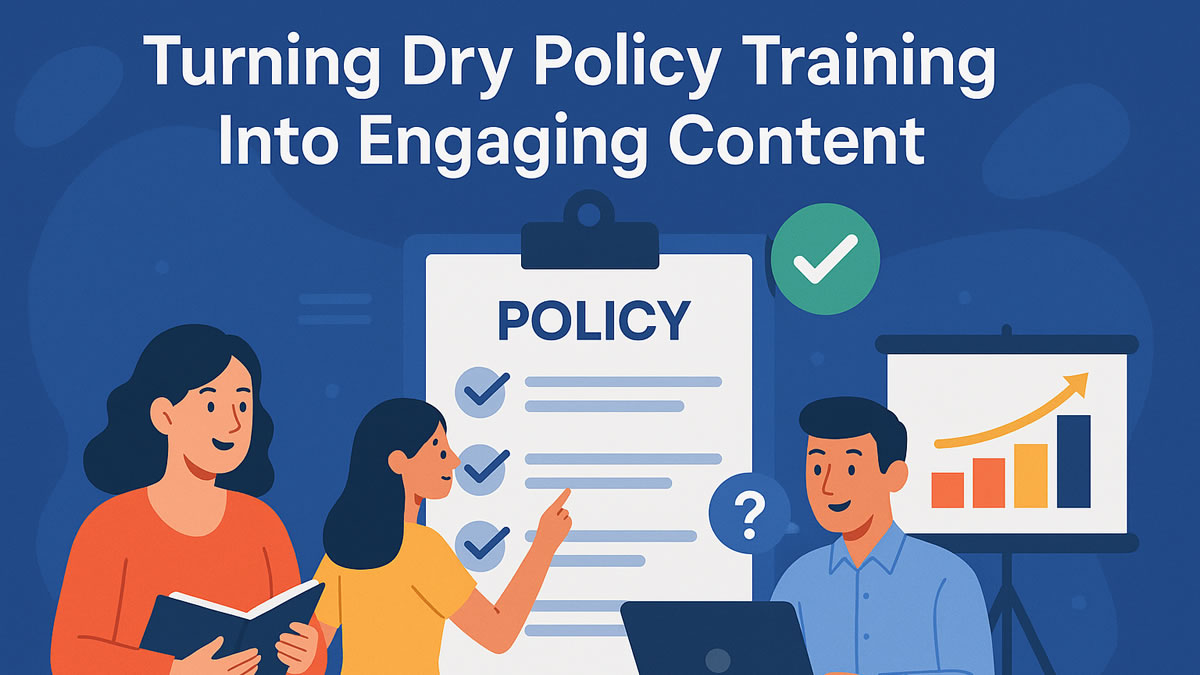
Compliance training becomes more engaging when employees do something with the material instead of passively clicking through it.
That does not mean every policy needs to become entertainment. It means the training has to feel relevant, active, and useful enough that employees can connect it to real work.
For HR, L&D, and compliance teams, the goal is not simply to make training "fun." The goal is to help employees understand expectations, remember the right actions, and apply policies when it matters.
This guide covers practical ways to make compliance training more engaging without weakening the seriousness of the topic.
Why Compliance Training Often Feels Boring
Most employees do not dislike compliance because they think the topics are unimportant. They disengage because the format often works against learning.
Common problems include:
- Long modules that ask employees to sit through too much at once
- Dense policy language written for legal precision, not learning
- Generic examples that do not match the employee's actual role
- One-time annual training with little reinforcement
- Quizzes that check completion more than understanding
- Little feedback beyond "correct" or "incorrect"
Several training providers and workplace learning teams point to the same pattern: compliance training is more effective when it is contextual, interactive, scenario-based, and connected to real decisions employees make at work. For example, Articulate emphasizes practical context and learner relevance in compliance training, Skillcast highlights role-specific relevance, and Moodle recommends smaller checks and interactive activities throughout the process.
The implication is simple: employees need a reason to care, a chance to practice, and feedback that helps them improve.
1. Start With the Behavior, Not the Policy
The fastest way to make compliance training more engaging is to stop treating the policy as the outline.
Policies are usually organized for completeness. Training should be organized around behavior.
Instead of asking:
What does the policy say?
Ask:
What should employees do differently after this training?
Examples:
| Policy Area | Weak Training Goal | Better Behavior Goal |
|---|---|---|
| Data privacy | Understand the privacy policy | Identify when customer data should not be shared |
| Harassment prevention | Complete annual conduct training | Recognize and report inappropriate workplace behavior |
| Cybersecurity | Learn password rules | Spot risky login, MFA, and phishing situations |
| Safety | Review safety procedures | Choose the correct response during a workplace hazard |
| Code of conduct | Read the handbook | Apply company standards to realistic decisions |
Once the behavior is clear, the rest of the training becomes easier to design.
2. Break Long Training Into Shorter Knowledge Checks
Compliance topics often get packed into long annual sessions because teams need to cover everything. The problem is that coverage is not the same as retention.
A more engaging structure is to break content into short knowledge checks:
- 5 to 10 questions on one policy area
- 3 to 5 realistic workplace scenarios
- A short refresher one week later
- A quick follow-up for the most missed concepts
This works especially well for:
- Cybersecurity awareness
- Safety refreshers
- Code of conduct review
- Data privacy basics
- Anti-harassment reporting procedures
- New policy rollouts
Shorter modules are easier to finish, easier to update, and easier to repeat. They also give HR and L&D teams a clearer view of what employees actually understood.
3. Use Scenarios Instead of Abstract Rules
Employees rarely apply compliance knowledge in the abstract. They apply it in messy situations with incomplete information.
That is why scenarios are one of the strongest ways to make compliance training more engaging.
Instead of asking:
What is confidential information?
Ask:
A customer emails a spreadsheet with personal information to the wrong department. What should you do first?
Instead of asking:
What is a conflict of interest?
Ask:
A vendor offers you tickets to a sold-out event before contract renewal. What is the safest next step?
Scenario questions work because they make employees practice judgment. They also reveal whether someone can apply the policy, not just recognize a definition.
Good scenarios should be:
- Short enough to read quickly
- Specific to the employee's role or department
- Focused on one decision
- Written in plain workplace language
- Followed by feedback explaining the right answer
4. Make Feedback Useful
Many compliance quizzes give employees a score but little explanation. That misses the teaching moment.
Better feedback explains why an answer is right or wrong.
Weak feedback:
Incorrect. Try again.
Better feedback:
Not quite. If a request involves customer data, verify the recipient and follow the approved sharing process before sending anything.
Useful feedback should:
- Reinforce the correct action
- Explain the risk in plain language
- Point employees back to the relevant policy section when needed
- Avoid shaming employees for mistakes
This is especially important for required training. Employees are more likely to engage when the training helps them succeed instead of feeling like a trap.
5. Add Game-Based Practice Without Making Compliance Feel Silly
Game-based learning can make compliance training more active, but it needs the right tone.
The point is not to trivialize serious topics. The point is to add practice, feedback, momentum, and participation.
Good game-based compliance training can include:
- Quick team knowledge checks
- Scenario challenge rounds
- "Spot the risk" questions
- Low-stakes retry rounds
- Leaderboards for optional group sessions
- Timed refreshers for simple recall topics
- Self-paced practice before a formal assessment
This is where BrainFusion can fit well. HR or L&D teams can take approved compliance content, generate or import questions, review them for accuracy, and turn them into a short browser-based game employees can join without installing software.
BrainFusion should be used as an engagement and reinforcement layer. It should not replace your system of record, legal review process, or required compliance documentation.
For a deeper framework, see Turning Dry Policy Training Into Engaging Content.
6. Make Training Role-Specific
Generic compliance training often loses employees because it sounds like it was written for everyone and no one.
A frontline employee, manager, sales rep, HR specialist, and IT admin may all need the same policy, but they usually need different examples.
Role-specific examples make training feel more relevant:
- Managers practice how to respond to a report
- Sales teams practice data-sharing boundaries
- Customer support teams practice privacy and escalation rules
- Operations teams practice safety and incident response
- Remote employees practice cybersecurity and device security
You do not need to create a fully separate course for every role. Start by changing the scenarios and knowledge checks.
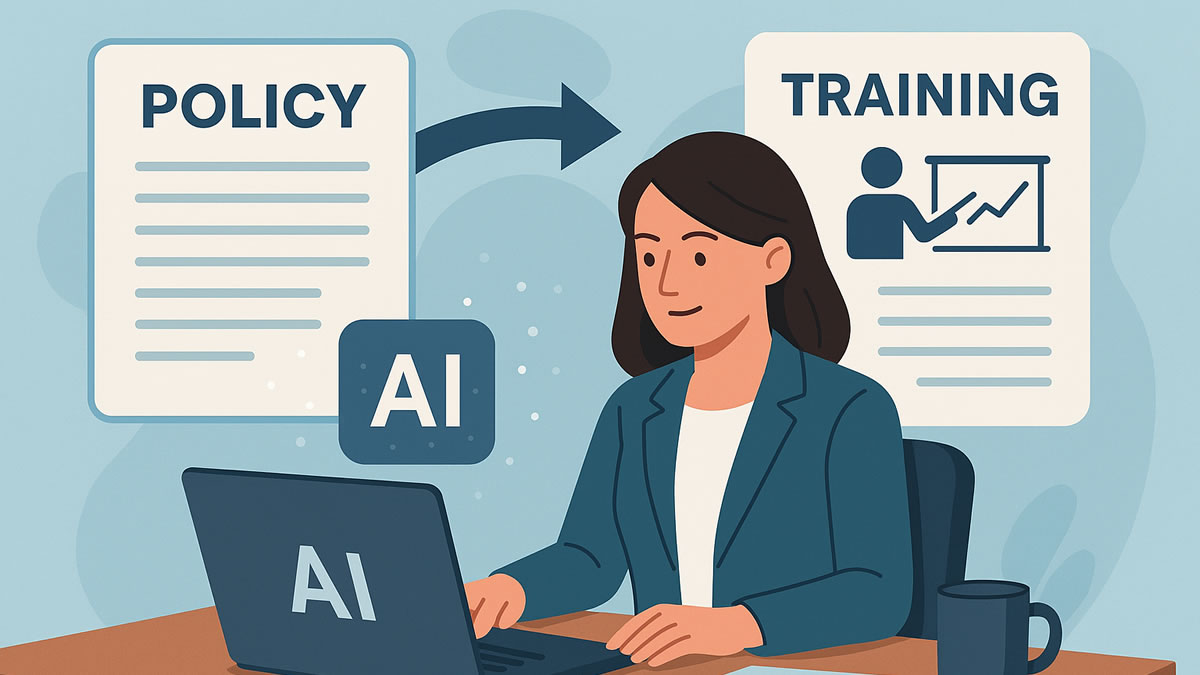
With AI-assisted tools, HR teams can create a first draft of role-specific questions from the same approved policy, then review and edit before launch. For more on that workflow, read Using AI to Build Training Quickly From Existing Policies.
7. Use Analytics to Improve the Next Training
Engaging compliance training should give the training team useful signals.
Instead of only asking "Did employees finish?", ask:
- Which questions were missed most often?
- Which policy concepts confused employees?
- Did managers and employees miss different items?
- Did the refresher improve results?
- Which topics need clearer examples?
Question-level analytics are especially useful because they show where the training needs to improve.
For example:
- If many employees miss a phishing reporting question, the reporting process may need to be clearer.
- If managers miss a harassment escalation scenario, manager training may need a separate follow-up.
- If employees miss a data-sharing rule, the policy language may be too vague or buried.
Completion matters, but understanding matters more.
A Simple Compliance Training Engagement Plan
Here is a practical rollout HR and L&D teams can use.
Step 1: Choose one compliance topic
Start with one focused area:
- Phishing emails
- Reporting workplace concerns
- Data privacy basics
- Safety procedures
- Code of conduct scenarios
Step 2: Pick one behavior
Define what employees should do differently.
Example:
Employees can identify suspicious requests and report them through the approved channel.
Step 3: Create 8 to 12 questions
Use a mix of:
- Scenario questions
- "What should you do first?" questions
- Common mistake questions
- Plain-language policy checks
Step 4: Add feedback
Explain each answer in one or two sentences.
Step 5: Run it as a short game or knowledge check
Keep the activity short enough to complete in one sitting. For most teams, 5 to 10 minutes is a good starting target.
Step 6: Review the results
Look for the top missed questions and create a follow-up refresher.
This creates a repeatable loop:
Train, practice, review the data, reinforce the weak spots.
That loop is more useful than one long training employees forget a month later.
Example: Turning a Policy Into an Employee Training Game
Imagine your company needs to refresh employees on data privacy.
Traditional format:
- 30-minute slide deck
- Policy acknowledgment
- Final quiz
More engaging format:
- 8-question BrainFusion game
- 5 scenario questions
- 3 rule-check questions
- Immediate feedback after each answer
- Follow-up review of the top missed items
Sample questions:
- A coworker asks you to send a customer list to their personal email so they can work from home. What should you do?
- A vendor asks for employee contact data for a project. What should you verify first?
- You accidentally send a document to the wrong person. What is the first step?
- Which information should be treated as confidential?
- A customer requests deletion of their data. Who should handle the request?
This approach gives employees active practice and gives the training team better visibility into what needs reinforcement.
Common Mistakes to Avoid
Avoid these traps when improving compliance training:
- Making the training playful without making it useful
- Using generic examples that do not match employee roles
- Measuring only completion
- Creating questions that test trivia instead of decisions
- Letting AI generate unreviewed policy content
- Overusing competition for sensitive topics
- Treating a game or quiz as a replacement for formal compliance documentation
The best version is balanced: serious content, practical scenarios, active recall, immediate feedback, and clear follow-up.
Final Takeaway
Compliance training becomes more engaging when employees can practice real decisions, get useful feedback, and see how the training connects to their work.
For HR and L&D teams, the best first step is small:
Take one approved policy, choose one behavior, create a short knowledge check, and review the results. Then use the missed questions to build the next refresher.
BrainFusion can help teams turn existing compliance material into short, browser-based learning games with AI-assisted question generation, editable content, immediate feedback, and question-level results.
Turn one compliance topic into a short training game
Create a browser-based knowledge check from existing policy or onboarding content, then review what employees understood.