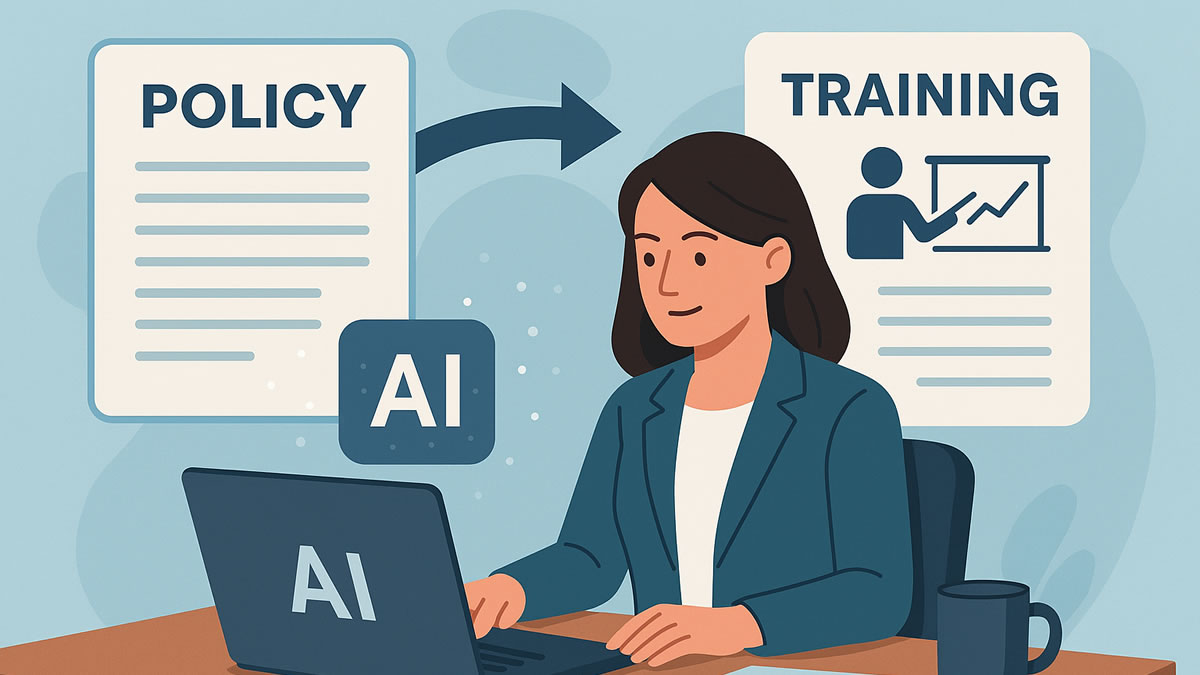
AI can help turn an approved policy into a first draft of training questions. The safe starting point is a narrow excerpt, a defined audience, and a clear rule that the policy owner can verify.
It cannot decide what an ambiguous policy means or guarantee that every generated answer remains faithful to the source. Treat AI output as a draft, not an approved interpretation.
This guide focuses on reviewing policy-derived questions. For the broader workflow, including document preparation, tool selection, and HR-system planning, see how to turn company documents into employee training with AI.
Start With a Source You Can Approve
Before generating anything, identify:
- The policy owner and current approved version.
- The employee group that needs the training.
- The decision employees need to practice.
- The exact section that supports the correct answer.
- Any exceptions, thresholds, deadlines, or required approvals.
- Whether the material is permitted in the AI tool you plan to use.
Do not upload employee records, customer details, credentials, or sensitive internal information unless your organization has authorized that use. A document being available to you does not automatically make it appropriate for an external processing tool.
If two documents disagree, stop and ask the owner to resolve the conflict. Generating questions from both versions will not settle which rule applies.
Keep the First Draft Small
Choose one policy section rather than asking AI to process an entire handbook at once.
For example, a trainer might focus on the difference between a routine purchase and one requiring additional approval. That is easier to review than a draft covering expenses, travel, vendor selection, and data handling together.
Keep the source's meaning intact. A shorter instruction is not an improvement if it drops an exception or turns a recommendation into a requirement.
NIST's Generative AI Profile identifies confabulation, including confidently presented incorrect content, as a generative AI risk. Providing a source does not remove the need to check the output.
Use a Reviewable Drafting Prompt
The following prompt is intended for an organization-approved AI drafting tool. It is not a claim that BrainFusion displays or stores every requested review field.
Using only the approved excerpt below, draft four multiple-choice practice questions for [employee role].
Focus on [one workplace decision]. For each question, provide one correct answer, plausible alternatives, a short explanation, and the supporting section of the excerpt.
Preserve all conditions, thresholds, deadlines, and exceptions. Do not invent an approval route, reporting address, or consequence.
If the excerpt does not determine an answer, flag the ambiguity instead of guessing.
Label any invented people or situations as fictional. Use no real employee or customer information.
Approved excerpt and version: [insert authorized source material].
Use the requested explanations and source references as reviewer aids. They are not evidence of accuracy until someone checks them against the original.
When bringing questions into a learning game, adapt them to its supported question format. Keep any separate review notes in your team's approved document workflow.
Check Every Question Against the Policy
Review the question, correct answer, alternatives, and explanation together.
Check the Decision
Does the question test something this employee actually needs to decide? Remove obscure detail unless recalling it is necessary for the work.
Check the Conditions
Does the answer change for a different amount, location, account type, time period, or role? Include the relevant conditions in the question.
Check the Wrong Answers
Could an alternative also be valid under an exception? Could it teach an unsafe shortcut even if it is marked wrong? Rewrite alternatives that create confusion.
Check the Source Reference
Does the cited section exist, and does it support the answer? An AI-generated reference can look convincing while pointing to the wrong rule.
Check the Language
Read the question aloud. A complex sentence can turn a policy check into a reading test. Simplify the language without simplifying away the rule.
The employee knowledge-check guide provides a fuller question-writing template and examples.
Worked Example: Catch an Invented Approval Rule
This is a fictional purchasing policy, not a recommendation for your organization's controls.
Approved excerpt: Purchases above $500 require manager approval before ordering. Purchases of $500 or less use the standard purchasing form. Splitting a purchase to avoid approval is prohibited.
Faulty AI draft: "An employee needs equipment costing $500. Should they obtain manager approval before ordering?"
Draft answer: "Yes. All purchases of $500 or more need manager approval."
The draft changed "above $500" into "$500 or more." It also omitted the standard form, which is the relevant action for the stated amount.
A corrected practice question could ask:
An employee plans one purchase totaling $500. Under this fictional policy, what should they do before ordering?
A. Use the standard purchasing form.
B. Obtain manager approval because the amount is above $500.
C. Split the purchase into smaller orders to avoid paperwork.
Correct answer: A. Exactly $500 falls within the stated standard-form route. The exception for amounts above $500 does not apply, and splitting is prohibited.
The useful lesson is the review process: check the boundary, the wording, and the alternative actions. For your real training, use the policy owner's approved interpretation.
Review, Publish, and Maintain Deliberately
Before employees play, have the policy owner approve the content and let a representative learner try the questions. Ask what was unclear.
Keep a simple review record outside the game:
- Source document, version, and relevant sections.
- Draft questions and any corrections.
- Reviewer and approval date.
- Where the final activity is used.
- The event that should trigger another review.
When the policy changes, identify which questions depend on the changed rule. Revise and reapprove them, and check any reused activities. Updating a source file does not automatically synchronize every training game.
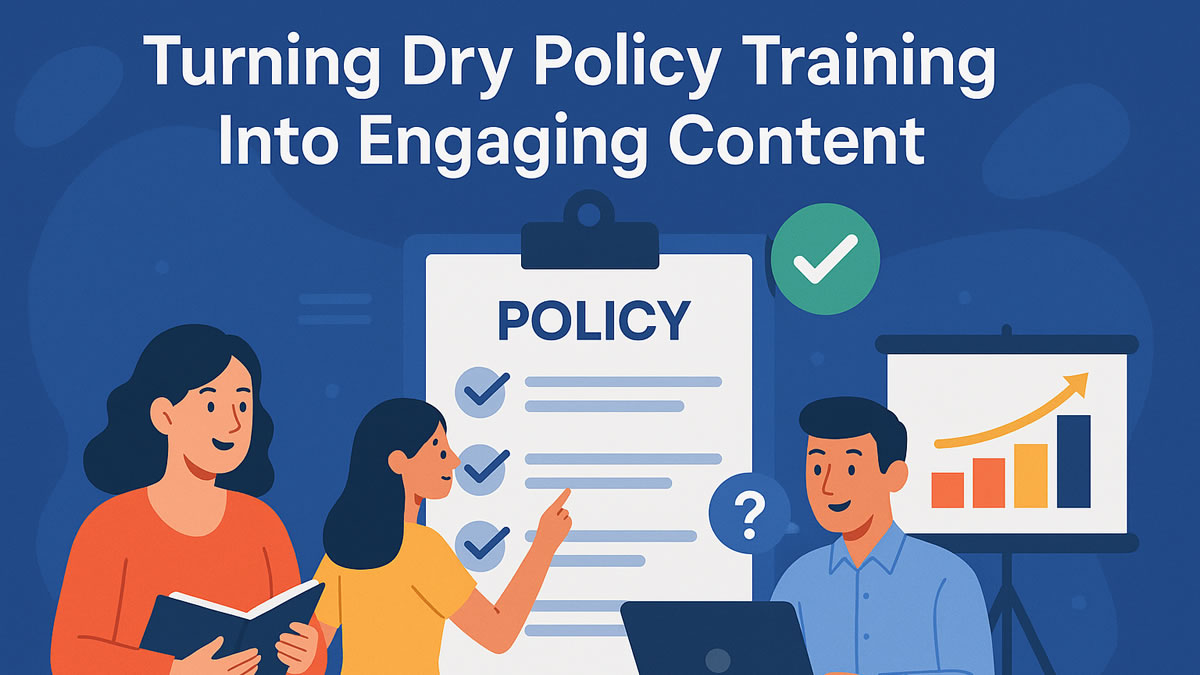
For ideas on teaching the approved rule, read turning dry policy training into engaging content. For participation and facilitation choices, see making compliance training more engaging.
Use BrainFusion for Practice, Not Policy Approval
BrainFusion supports manually entered questions, CSV import, and AI-assisted game creation. A straightforward starting point is to use approved text for an AI draft, then review and edit the questions before launching a browser-based activity.
Employees can join with a game code, and trainers can review question-level results to plan follow-up. The standard workflow is not a verified identity system or a compliance record of completion. Keep policy approvals, required acknowledgments, and official records in the appropriate systems.
Game capacity and AI usage are different limits. The free plan includes up to five games and three one-time AI credits. Paid plans allow unlimited games, but AI generation still uses credits. Check current pricing and credit allowances rather than assuming unlimited games means unlimited AI generation.
The goal is a reviewed practice activity with a traceable source. Start there before expanding to a larger program. The corporate-training overview explains BrainFusion's role.
Turn an Approved Rule Into Practice
Create a short question draft, verify it against your policy, and launch a focused learning game.