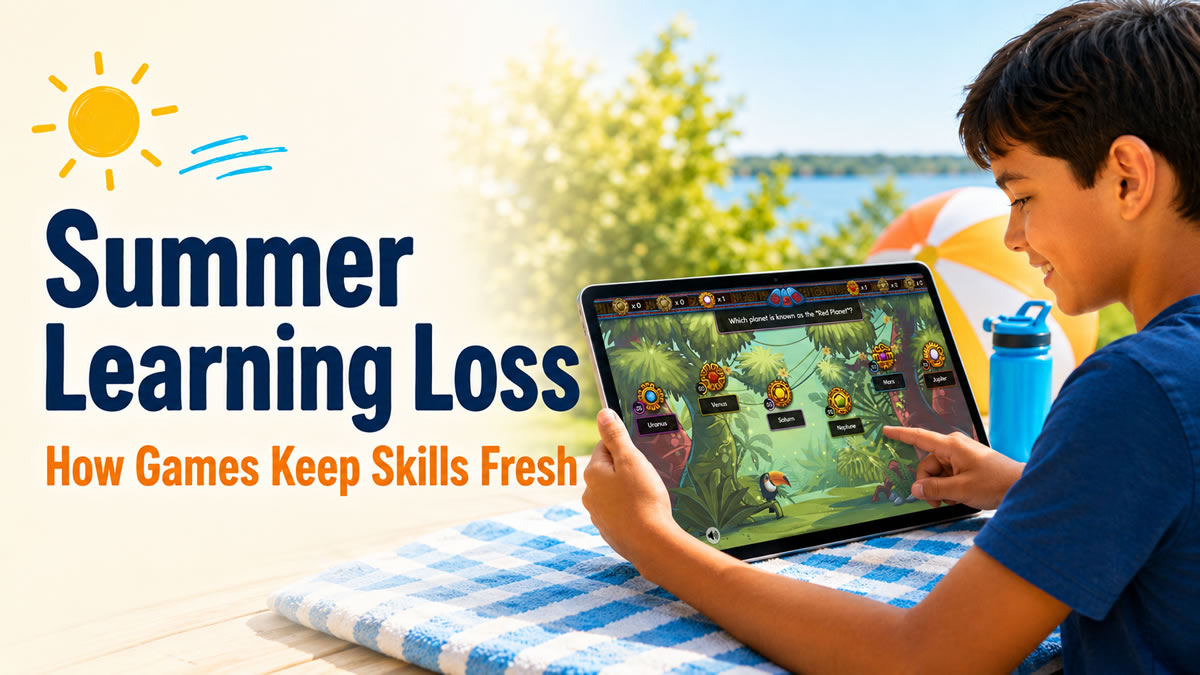
Every teacher knows the moment: students return in August excited, taller, and full of stories — but some of last spring’s skills feel a little fuzzy.
That is the challenge behind summer learning loss. Over long breaks, students may forget math facts, vocabulary, reading strategies, science concepts, or language patterns they worked hard to build during the school year. The goal is not to turn summer into more school. The goal is to keep key skills active with short, low-pressure practice that students will actually want to do.
Games can help. If you have already used game-based review for holiday break practice, the same approach scales well across the longer summer window.
When summer review feels like play, learners get the benefits of retrieval practice, immediate feedback, repetition, and confidence-building without the heaviness of a worksheet packet. Whether you are a classroom teacher preparing optional summer review, a tutor supporting students between terms, or a parent looking for something productive and fun, game-based learning can make summer skill practice feel manageable.
Why Skills Fade During Summer Break
Learning does not disappear all at once. It fades when students go weeks without using it.
A student who mastered fraction comparison in April may not automatically remember every strategy in July. A reader who made progress with inference questions may need light practice to keep those thinking routines sharp. A Spanish learner who confidently conjugated present-tense verbs in May may hesitate after two months away from daily practice.
That is normal. Researchers still debate the size and consistency of the “summer slide,” and recent analyses show that summer learning patterns can vary by grade, subject, assessment, and student. Still, several modern studies find that test scores often flatten or drop during summer, especially in math, which makes light review a practical precaution rather than a panic button. For a helpful overview of that nuance, see this Brookings analysis of summer learning loss. These patterns apply after shorter breaks, too — the post-spring break re-engagement guide covers comparable strategies for the weeks after April.
Memory strengthens when students revisit ideas over time. The most helpful summer review is usually:
- Short — 5 to 15 minutes is often enough
- Consistent — a few times per week works better than one long cram session
- Mixed — rotating old and recent topics keeps skills flexible
- Low-stakes — students should feel successful, not tested
- Actionable — feedback should show what to review next
Games fit this pattern well because they give students a reason to practice. Points, levels, timers, streaks, leaderboards, and replayable challenges create momentum. More importantly, good learning games ask students to retrieve information, make decisions, and correct mistakes in the moment.
💡 Pro Tip
For summer practice, aim for “little and often.” A 10-minute game three times a week is usually more realistic than a 60-minute review session students avoid.
Why Games Work for Summer Review
Games are not just a way to make review more colorful. When designed well, they support the way memory works.
Retrieval practice keeps knowledge active
Retrieval practice means students pull information from memory instead of simply rereading it. A game question like “Which fraction is greater: 3/4 or 5/8?” asks the student to think, compare, and choose. That active recall strengthens memory more than passively looking over notes.
The Institute of Education Sciences practice guide on organizing instruction and study recommends spacing learning over time and using quizzes to re-expose students to key content. A What Works Clearinghouse review of research on retrieval practice also found positive evidence for retrieval-based study compared with other study approaches.
Immediate feedback helps students correct errors
Summer review works best when students know right away whether they are on track. Games can show immediate feedback after each question, helping learners adjust before misconceptions become habits.
The Education Endowment Foundation describes feedback as information that helps learners improve by connecting their current performance to a learning goal. For summer practice, that means a missed question should not just say “wrong.” It should point students toward the skill, strategy, or concept to try again.
Repetition feels less repetitive
Students may resist doing the same worksheet twice. But they will often replay a game to beat a score, unlock progress, or improve accuracy. That replay loop creates more practice without making review feel like punishment.
This matters because spaced review is more powerful than one long cram session. The Australian Education Research Organisation’s guide to spacing and retrieval practice recommends giving students multiple low-risk opportunities to recall prior learning over time.
Variety keeps motivation higher
The same question set can feel fresh when it appears in different formats. A math review can become a quick quiz one day, a flashcard challenge the next, and an adventure-style game later in the week. Variety matters during summer because attention is competing with camps, vacations, sports, and downtime.
Research on educational games is not a blank check for “anything with points.” Design matters. A meta-analysis of serious games found positive effects on learning and retention, especially when games were paired with other instructional supports, multiple sessions, or group play. A separate meta-analysis of gamification in learning found small positive effects on cognitive, motivational, and behavioral outcomes, while also noting that results depend on design choices.
BrainFusion supports this kind of flexible practice by letting educators create one question set and use it across multiple game modes, including Quiz Quest, Artifact Adventure, Ninja Fruit Frenzy, Flashcard Fusion, Helicopter Hangtime, and Smart Shot.
5 Summer Game Ideas to Keep Skills Fresh
You do not need a complicated summer program to make a difference. Start with a few targeted games built around the highest-value skills students should retain.
1. The “Last 10 Skills” Review Game
Before the school year ends, choose 10 essential skills students will need next year.
For example:
- 4th grade math: multiplication facts, fractions, place value, multi-step word problems
- Middle school ELA: theme, inference, text evidence, vocabulary in context
- Biology: cell parts, ecosystems, genetics vocabulary, experimental design
- Spanish: present-tense verbs, common irregulars, greetings, classroom vocabulary
Create a short game with 20 to 30 questions that mixes those skills together. Students can replay it throughout the summer without needing a new activity every week.
Best BrainFusion mode: Quiz Quest for quick review or Flashcard Fusion for repeated practice.
2. Weekly Skill Sprints
A skill sprint is a focused 5- to 10-minute challenge. Instead of reviewing everything at once, each week targets one small area.
Example summer sprint schedule:
- Week 1: multiplication and division facts
- Week 2: fractions and decimals
- Week 3: vocabulary review
- Week 4: reading comprehension
- Week 5: mixed challenge
- Week 6: preview skills for next year
This works especially well for tutors, summer school teachers, and homeschool families because the routine is predictable but not overwhelming.
Best BrainFusion mode: Ninja Fruit Frenzy for speed-and-accuracy practice or Smart Shot for short bursts of review.
3. Family Trivia Night
Summer learning does not have to happen alone. Turn review into a family trivia night where students compete with siblings, parents, cousins, or friends.
Keep it light:
- 15 questions
- Mixed topics
- Funny team names
- No grades
- Optional small prize, like choosing dessert or the next movie
Family review works best when the questions are accessible. Include some “confidence questions” students can answer quickly, then add a few challenge questions to stretch thinking.
Best BrainFusion mode: Quiz Quest or Artifact Adventure for group play.
4. “Beat Your Score” Flashcard Challenges
Some skills need repetition: math facts, vocabulary, formulas, dates, definitions, grammar rules, and language conjugations.
Instead of asking students to memorize a long list, create a flashcard game where they try to improve over time. The goal is personal progress, not perfection.
Students can track:
- Highest score
- Most improved topic
- Number of questions mastered
- Streaks across the week
- Missed questions to replay
This is especially helpful for students who need confidence. They can see growth without comparing themselves to the whole class.
Best BrainFusion mode: Flashcard Fusion.
5. Back-to-School Bridge Game
At the end of summer, create a bridge game that connects last year’s skills to the first unit of the new year.
For example:
- Incoming 6th grade math: fraction review → ratios
- Incoming biology: scientific method → lab safety and variables
- Incoming Spanish 2: present-tense review → preterite introduction
- Incoming English 9: theme and evidence → literary analysis
This helps students start the year with momentum. It also gives teachers useful insight into which skills may need reteaching during the first week.
Best BrainFusion mode: Artifact Adventure for exploration or Quiz Quest for a quick diagnostic review.
A Simple 4-Week Summer Practice Plan
Here is a low-prep structure teachers can share with families or use in tutoring sessions.
Week 1: Confidence Review
Choose skills students already know well. The goal is to build momentum.
Game idea: 20-question review with mostly familiar content
Student goal: “I can still do this.”
Week 2: Mixed Practice
Blend two or three related topics. This helps students decide which strategy to use instead of relying on obvious patterns. This kind of mixed review connects well with evidence-based recommendations to space learning, interleave practice, and revisit key content after a delay.
Game idea: Fractions + decimals + word problems
Student goal: “I can choose the right strategy.”
Week 3: Challenge Round
Add slightly harder questions, but keep the game low-stakes. Encourage replay and improvement.
Game idea: Timed challenge or adventure mode
Student goal: “I can improve with practice.”
Week 4: Preview and Refresh
Mix old skills with a few preview questions for the next grade, unit, or course.
Game idea: “Ready for Next Year?” game
Student goal: “I know what is coming next.”
🎮 BrainFusion Summer Review Idea
Create one “Summer Skills Refresh” question set, then replay it in different game modes each week. Students get variety while you avoid rebuilding content from scratch.
Create Game Free →Best Practices for Summer Learning Games
Summer review should feel supportive, not stressful. A few simple choices can make the difference between practice students enjoy and practice they avoid.
Best Practices:
- Keep games short. Ten focused questions are better than 50 rushed ones.
- Mix easy and challenging items. Students need confidence and growth.
- Use immediate feedback. Let mistakes become learning moments.
- Repeat important skills. Spaced practice helps learning stick.
- Rotate formats. Use quizzes, flashcards, adventure games, and quick challenges.
- Track patterns, not just scores. Look for which questions students miss repeatedly.
- Celebrate improvement. Summer practice is about staying sharp, not being perfect.
Common Mistakes to Avoid:
- ❌ Turning summer practice into a full extra course
- ❌ Assigning long packets without feedback
- ❌ Reviewing only easy facts and skipping deeper thinking
- ❌ Making every activity timed
- ❌ Using games only as rewards instead of meaningful practice
- ❌ Comparing students publicly when the goal is confidence
For teachers, the biggest win is preparation. Build a small library of summer review games before the year ends. For tutors and parents, the biggest win is consistency. Pick two or three weekly practice moments and keep them predictable.
What to Review Before Summer Starts
Not every skill needs equal attention. Focus on the skills that act as bridges to future learning.
Good summer review targets include:
- Foundational math skills students will use again immediately
- Reading comprehension routines like inference, main idea, and evidence
- Academic vocabulary from science, social studies, and ELA
- World language basics such as high-frequency verbs and phrases
- Writing conventions like sentence structure, transitions, and punctuation
- Study habits such as recalling, checking, and correcting answers
A helpful question for teachers is: “What do I hope students do not have to relearn from scratch in August?”
Those are the skills worth turning into games.
BrainFusion’s question-level analytics can also help identify what belongs in a summer review set. If students consistently missed specific questions during end-of-year review, those items can become the foundation for a targeted summer refresh. Free and paid plans are available for individual teachers, tutors, and homeschool families.
Keep Summer Learning Light, Useful, and Fun
Summer learning loss is a real concern, even though the research picture is more nuanced than a simple “all students lose the same amount” story. Students need rest. Families need flexibility. Teachers need tools that do not add hours of prep. Games meet in the middle by turning essential review into short, repeatable practice students are more likely to complete.
The best summer learning games are not about covering everything. They are about keeping the most important skills within reach.
Start small. Choose 10 to 20 key questions. Make the game replayable. Encourage students to beat their own score. Mix in old skills, recent skills, and a few preview questions. By the time school starts again, students will not just remember more — they will return with more confidence.
For students who need more structured support, research on well-designed summer learning programs suggests that consistent attendance and strong program design matter. For everyone else, short summer games can be a simple way to keep learning alive without taking over the break.
Turn Summer Review Into Play
Create a low-stakes review game students can play from home, tutoring sessions, or summer school.