You sit down to study with the best intentions. Then your notes look flat, your to-do list feels endless, and somehow reorganizing your desk starts to feel more urgent than learning anything.
That is not always a motivation flaw. It is often a design flaw.
Most self-study systems ask people to rely on willpower alone. But motivation tends to grow when progress is visible, feedback is immediate, and the next step feels achievable. That is exactly why gamification has attracted so much attention in education research. Clear goals, quick wins, challenge, and rewards can make learning feel more actionable and more repeatable.
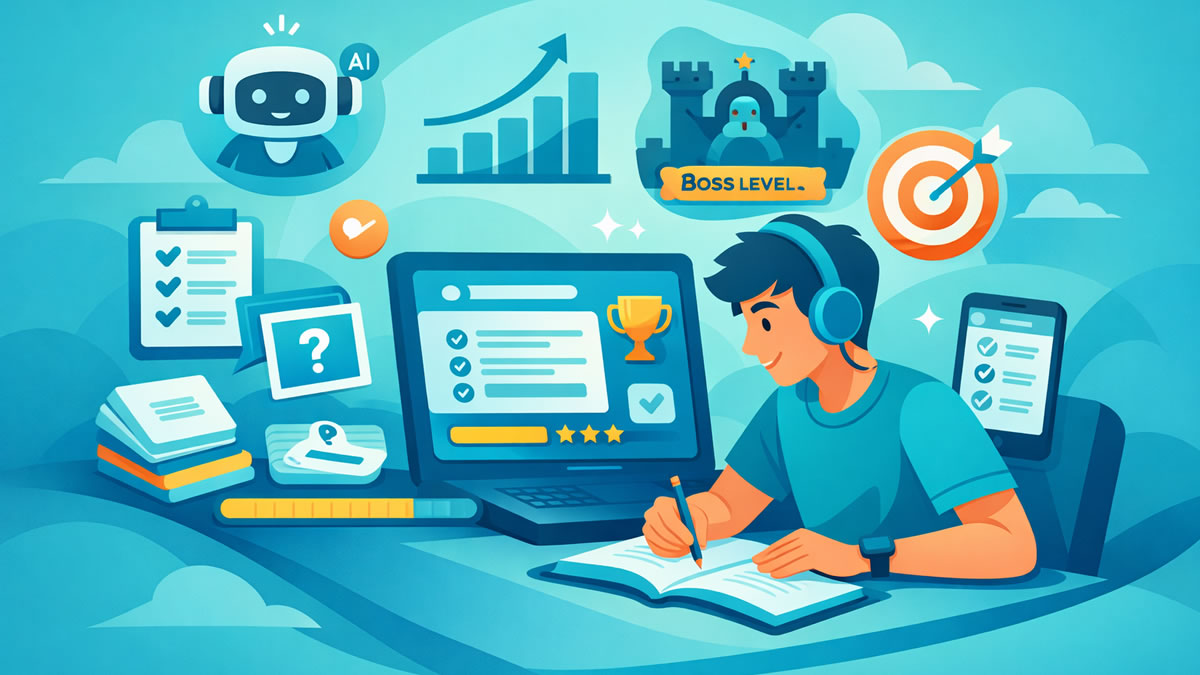
When you combine those game mechanics with AI, studying can feel less like dragging yourself through a checklist and more like progressing through levels. AI tools can help generate questions, adapt difficulty, remix topics, build flashcards, and create fresh practice on demand. UNESCO’s guidance on generative AI in education also notes that these tools can support teaching and learning when they are used with a human-centered and pedagogically sound approach.
The result is not just “more fun.” When gamified study systems are built around practice testing, distributed practice, and interleaved practice, they line up with some of the most consistently supported learning strategies in cognitive science.
The Real Reason Gamified Studying Feels Better
A lot of people hear “gamification” and think points, badges, and leaderboards. Those can help, but they are not the whole story.
What makes game-like study routines effective is that they answer four motivation questions fast:
- What am I trying to do right now?
- How will I know I am making progress?
- What happens if I succeed?
- What should I do next?
Traditional study sessions often leave those questions fuzzy. Read Chapter 4 is vague. Review your notes is vague. Prepare for the exam is very vague.
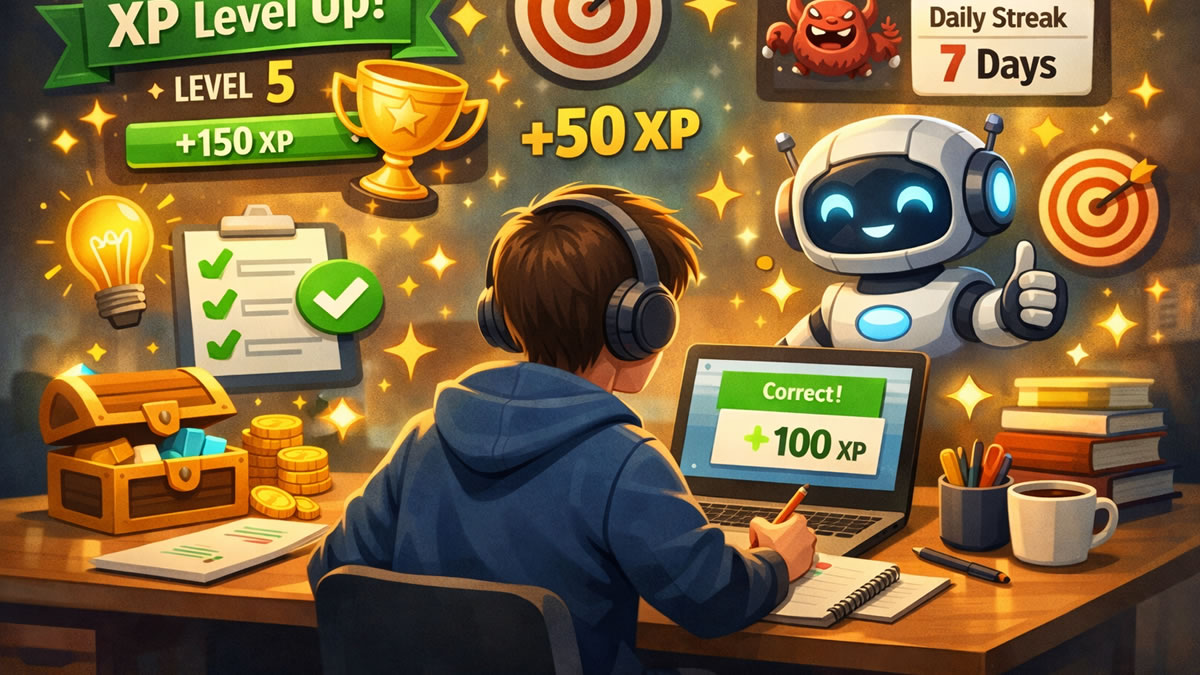
Games are different. They create a target. Earn 50 XP. Finish 3 rounds. Beat your last score. Clear today’s quest. That clarity matters.
AI makes it easier to build that clarity into self-study. Instead of manually creating quizzes, challenge cards, reflection prompts, and review rounds, you can use AI to generate them in seconds. That lowers the setup cost, which matters because even a great system will fail if it takes too much effort to maintain.
💡 Pro Tip
If your study system feels hard to start, reduce the setup before you try to increase discipline. A simple daily quest is usually more effective than an ambitious but fragile plan.
The Learning Science Behind the Fun
Good gamified studying is not just entertaining. It can align with several research-backed learning principles.
Retrieval practice turns memory into action
Re-reading notes can feel productive because it is familiar. But familiarity is not the same as mastery. Retrieval practice pushes you to actively recall what you know without looking first, and research reviews consistently rate practice testing among the most useful study techniques.
That is why quizzes, flashcards, mini-tests, and “boss battles” work so well. They make your brain retrieve information instead of passively recognizing it.
AI helps by generating more retrieval opportunities. You can turn a chapter summary, a set of notes, or a training document into question rounds almost instantly. BrainFusion, for example, is built around turning content into playable learning activities, which can make active recall easier to repeat without a lot of manual work.
Spaced repetition keeps knowledge from fading
The best time to review something is not only when you feel like it. It is often when you are just starting to forget it. Spacing effects research shows that spreading study over time can improve long-term retention, which is why distributed practice is considered a high-utility strategy.
This is where AI-powered flashcards and study tools can shine. BrainFusion's Flashcard Fusion, for example, uses the SM-2 algorithm to surface cards at optimal intervals, so you revisit weaker concepts more often and move mastered material into a lighter review cycle.
Immediate feedback builds momentum
Games tell you what happened right away. You were right. You missed it. Try again. Here is your score. Here is your next attempt.
That fast feedback loop matters in studying too. Feedback research shows that feedback can improve learning, while practical teaching guidance emphasizes that formative feedback helps learners identify gaps and next steps.
AI tools can speed that loop up by grading responses, explaining mistakes, and generating another variation of the same concept right away. The key is to use that speed in service of good pedagogy, not just novelty.
Interleaving makes you more flexible
Studying one topic in a block can feel smooth, but it sometimes hides weak understanding. Interleaving mixes related topics or problem types so you have to recognize what kind of thinking to use, not just repeat one pattern.
That is one reason game rounds can be so effective. Instead of drilling the same item 20 times in a row, you rotate through categories, formats, and levels. AI can create those mixed sets quickly, which helps self-learners get more varied practice without extra prep.
Want to try this with your own material? Create a free BrainFusion game in under a minute.
How AI Turns a Solo Study Session Into a Game Loop
The best AI study tools do more than generate content. They help create a repeatable loop:
Start with a clear mission
Example: finish one 10-question review round, one flashcard sprint, and one challenge question.Get active practice immediately
AI generates questions, prompts, examples, or scenarios from your material.See your results fast
You get scores, corrections, streaks, or clear feedback.Adjust the next round
AI can make the next set easier, harder, shorter, or more mixed.Log progress and come back tomorrow
This is where streaks, levels, and progress trackers help you stay consistent.
That loop matters because self-learning often breaks down between sessions, not during them. A good game loop makes it easier to return tomorrow because you know where to pick up.
Tools that fit this model
You do not need one perfect app. You need a small stack that fits your style.
1. AI quiz and game builders
These are useful when you want to turn notes, readings, or practice material into active recall games. BrainFusion is especially strong when you want the same content to become multiple playable formats, so you can review without feeling stuck in one mode. (For a more tactical setup guide, see our post on gamifying your study routine with AI tools.)
2. AI flashcard tools
Best for vocabulary, definitions, formulas, frameworks, and exam prep. Look for tools that support spaced review and quick practice bursts.
3. AI chat tools for challenge generation
These are great for “make me a harder version,” “quiz me one question at a time,” or “turn this topic into a scenario challenge.”
4. Habit trackers and focus apps
These provide the meta-game: streaks, completion tracking, session counts, and visible progress.
The key is not to collect apps like trophies. Pick tools that help you create challenge, feedback, and momentum with less friction.
Five Signs Your Study Routine Needs More Game Design
A lot of self-learners do not need more ambition. They need better mechanics.
1. You keep avoiding the start
That usually means the first step is too vague or too big. Replace “study biology” with “earn 30 XP by finishing one quiz round and one recap.”
2. You study, but cannot tell if it worked
If you end a session without evidence of what you remembered, you probably need more retrieval and scoring.
3. You get bored halfway through
Boredom often means too much sameness. Rotate formats: flashcards one day, timed quiz rounds the next, scenario prompts after that.
4. You only review what feels easy
That is common and very human. AI can help surface weak spots and generate practice that targets them instead of letting you hide in familiar material.
5. You quit after missing a day
Game design can help here too. Think in terms of “resume points,” not perfection. The goal is to restart quickly, not maintain an unbroken myth of discipline forever.
⚠️ Common Mistake
Do not gamify only the reward. If your system has streaks and points but very little active recall, it may feel motivating without improving retention much. Build the game around retrieval, review, and feedback.
A Simple Gamified Study Framework You Can Use This Week
You do not need a full productivity overhaul. Start with one repeatable system.
The 20-Minute Level-Up Session
Phase 1: Warm-up quest (3 minutes)
Review yesterday’s weak spots. Use AI flashcards or a short recap prompt.
Phase 2: Main challenge (10 minutes)
Do one focused round of active retrieval. This could be a quiz, scenario set, or concept challenge generated from your notes.
Phase 3: Boss battle (5 minutes)
Answer 3 harder questions with no notes. Make them cumulative if possible.
Phase 4: XP log (2 minutes)
Track what you completed, what you missed, and what tomorrow’s first mission will be.
This works because it creates structure without overcomplicating the routine. It also gives you a clear win condition, which makes studying easier to repeat.
Best practices:
- Keep each session small enough to start easily
- Track progress visually
- Mix easy wins with meaningful challenge
- Use AI to generate the next round before you stop
Common mistakes to avoid:
- ❌ Turning study time into endless setup time
- ❌ Using points without real retrieval practice
- ❌ Making every session equally difficult
- ❌ Treating one missed day like a total reset
Where BrainFusion Fits for Self-Learners
BrainFusion is often associated with teachers and trainers, but the same strengths are useful for individual learners too. If you are studying for an exam, building professional knowledge, learning a language pattern, or reviewing core concepts, BrainFusion can help turn static content into something more active.
That matters because motivation is easier to maintain when you are not stuck in one study format. One set of material can become a Quiz Quest challenge, a Flashcard Fusion review session, or a Ninja Fruit Frenzy round that refreshes the experience while keeping the learning goal intact.
For self-learners, that variety can be the difference between “I should study” and “I’ll do one more round.” You can start for free and explore from there.
And that is really the point of gamified learning. Not to make every session feel like a video game marathon, but to make practice easier to begin, easier to repeat, and more rewarding to stick with.
Make Studying Feel Winnable Again
If your self-study routine has been inconsistent, boring, or hard to restart, the answer is not necessarily more pressure. It may be a better system.
Gamified studying works because it makes progress visible. AI can make it easier because it reduces setup and helps generate fresh practice. Put them together, and learning can feel more interactive, personal, and manageable.
Start small. Build one quest. Use one AI-powered review tool. Track one streak. Then improve the system as you go.
That is how real momentum starts.
Turn your study notes into a game
Create AI-powered practice that feels more engaging, more active, and easier to repeat.
Sources linked in this post
- Frontiers: Meta-analysis on gamification in educational settings
- PubMed: Dunlosky et al. on effective learning techniques
- Roediger & Karpicke: The power of testing memory
- Cepeda et al.: Spacing effects in learning
- The Learning Scientists: Interleaving overview
- Frontiers: Meta-analysis of educational feedback research
- Stanford Teaching Commons: Formative assessment and feedback
- UNESCO: Guidance for generative AI in education and research