Most vocabulary instruction follows the same script: students copy definitions on Monday, complete a worksheet on Wednesday, take a quiz on Friday, and forget half the words by the following week.
The words did not stick because students never had to do anything with them. Copying a definition is passive. Recognizing a word on a matching quiz is barely more demanding. Neither one asks students to retrieve the word from memory, use it in context, or connect it to something they already know.
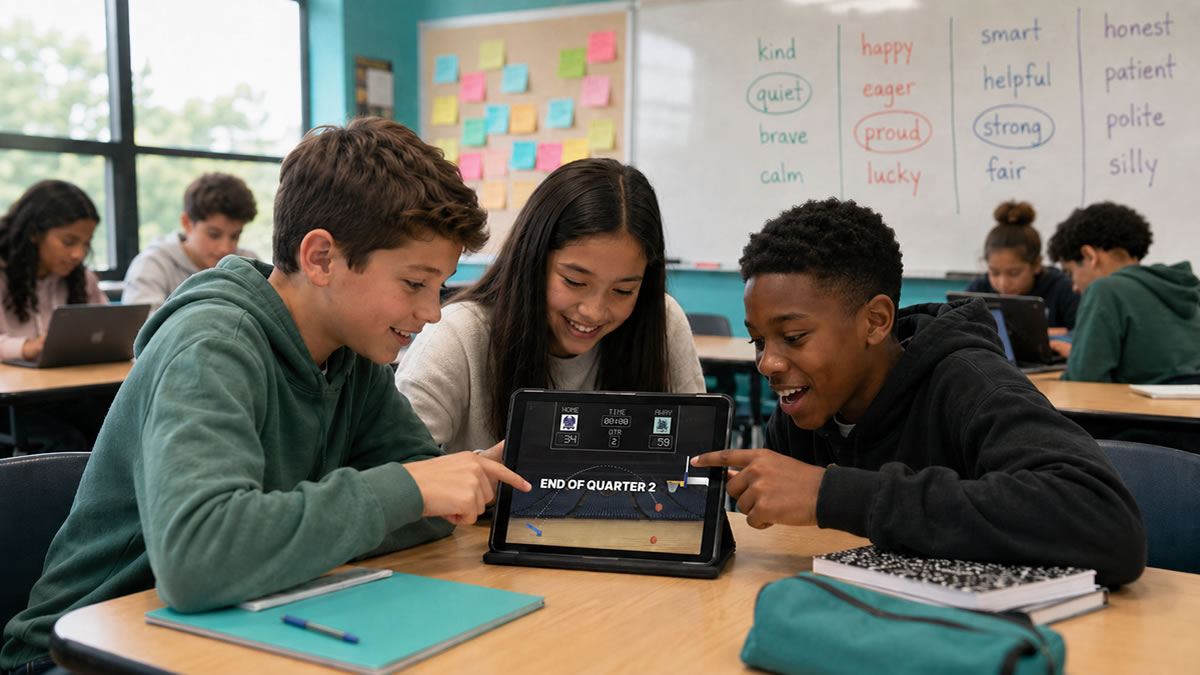
Vocabulary games fix that problem when they are built well. A good vocabulary game forces students to recall words repeatedly, apply them in new situations, and get immediate feedback on whether their understanding is accurate. The 8 games below work across grade levels and subjects, and most take five to fifteen minutes to run.
Why Definition Memorization Fails
Research on vocabulary instruction is unusually consistent: students learn words through repeated, meaningful encounters, not through a single exposure to a definition.
Reading Rockets' overview of teaching vocabulary notes that effective vocabulary instruction combines direct teaching of specific words with multiple exposures in varied contexts. One encounter with a definition is not enough for a word to become usable.
Robert Marzano's six-step process for vocabulary instruction makes games an explicit step. After students describe, restate, and represent a new term, they need periodic activities and games that let them play with the words. In Marzano's research, classrooms that used the full process saw substantially better vocabulary outcomes than classrooms that skipped the practice steps.
Games also deliver the practice conditions that memory research supports:
- Retrieval practice. Pulling a word from memory strengthens it more than rereading the definition. The Learning Scientists' guide to retrieval practice explains why the effort of recall is what drives retention.
- Spaced encounters. Words reviewed across days and weeks are remembered far longer than words crammed the night before a quiz. See the Learning Scientists on spaced practice.
- Immediate feedback. When students find out right away that they confused immigrate with emigrate, the error gets corrected before it settles in.
Teaching Move
If a vocabulary activity can be completed by copying from notes, it is not retrieval practice. Close the notebooks first. The struggle to remember is the part that builds memory.
1. Definition Detective
Instead of asking "What does erosion mean?", give students a short scenario and ask which vocabulary word it describes.
A river gradually carries away soil from its banks, making the channel wider each year. Which term describes this process?
This flips the usual recall direction. Students must recognize the concept in context, which is exactly what reading comprehension requires.
How to run it
- Pick 8 to 10 current vocabulary words.
- Write a one- or two-sentence scenario for each word.
- Present scenarios one at a time and have students choose the matching word from the full list.
- After each answer, ask one student to explain why the other options do not fit.
The explanation step matters. It surfaces near-miss confusions, like students who cannot separate weathering from erosion, while the whole class is listening.
2. Odd One Out
Show four words and ask which one does not belong, then require a reason.
photosynthesis, chlorophyll, respiration, stomata
There is often more than one defensible answer, and that is the point. A student who says "respiration, because the other three are about capturing energy" is doing more thinking than any definition quiz requires.
Use this as a warmup or a discussion starter. It works especially well for academic vocabulary in science and social studies, where words cluster into systems and categories.
3. Synonym Ladder
Give students a set of related words and have them order the words by intensity or shade of meaning.
annoyed, irritated, furious, displeased
Ordering forces students to compare words against each other instead of treating each word as an isolated fact. It also directly improves word choice in writing, because students start to see that synonyms are not interchangeable.
For a quick game version, present the set scrambled and award points for correct orderings, then have students defend any placement the class disagrees about.
4. Context Clue Challenge
Show a sentence with the vocabulary word used correctly or incorrectly, and have students judge it.
"The evidence was so ambiguous that every juror reached the same conclusion immediately." Correct or incorrect use?
This is one of the most revealing vocabulary checks you can run. Students frequently know a definition but cannot tell when a word is used wrong. Incorrect-usage items expose the difference between recognizing a word and understanding it.
Write your incorrect sentences around the misunderstanding students actually have. If students think ambiguous means "complicated," write the wrong sentence to match that confusion.
5. Picture Prompt
Show an image and ask students which vocabulary word it best represents, or reverse it and ask students to sketch a quick symbol for a word in 60 seconds.
Pairing a visual with a verbal label gives the memory two routes back to the word instead of one. The Learning Scientists describe this as dual coding, and it is one of the easier research-backed strategies to build into vocabulary practice.
Sketches do not need artistic quality. A stick figure pushing a boulder uphill is a perfectly good representation of persevere, and the ten seconds a student spends deciding what to draw is the learning.
6. Word Sort Relay
Post three or four category headers, then give teams a stack of vocabulary words to sort under the correct category.
Examples:
- ELA: sort words by connotation (positive, negative, neutral)
- Science: sort terms by body system, state of matter, or type of energy
- Math: sort terms by operation or by geometric versus algebraic
- World language: sort words by gender, tense, or theme
Sorting requires students to think about how words relate, which builds the category knowledge that definitions alone never create. Run it as a timed relay for energy, then review the two or three cards teams argued about.
7. Vocabulary Lightning Round
A fast, low-stakes review of 8 to 12 words that mixes question formats:
- Which word matches this definition?
- Which definition matches this word?
- Which sentence uses the word correctly?
- Which word completes this sentence?
- Which two words are closest in meaning?
The format variety is deliberate. If every question looks the same, students learn the pattern of the activity instead of the words. Mixing directions keeps retrieval honest.
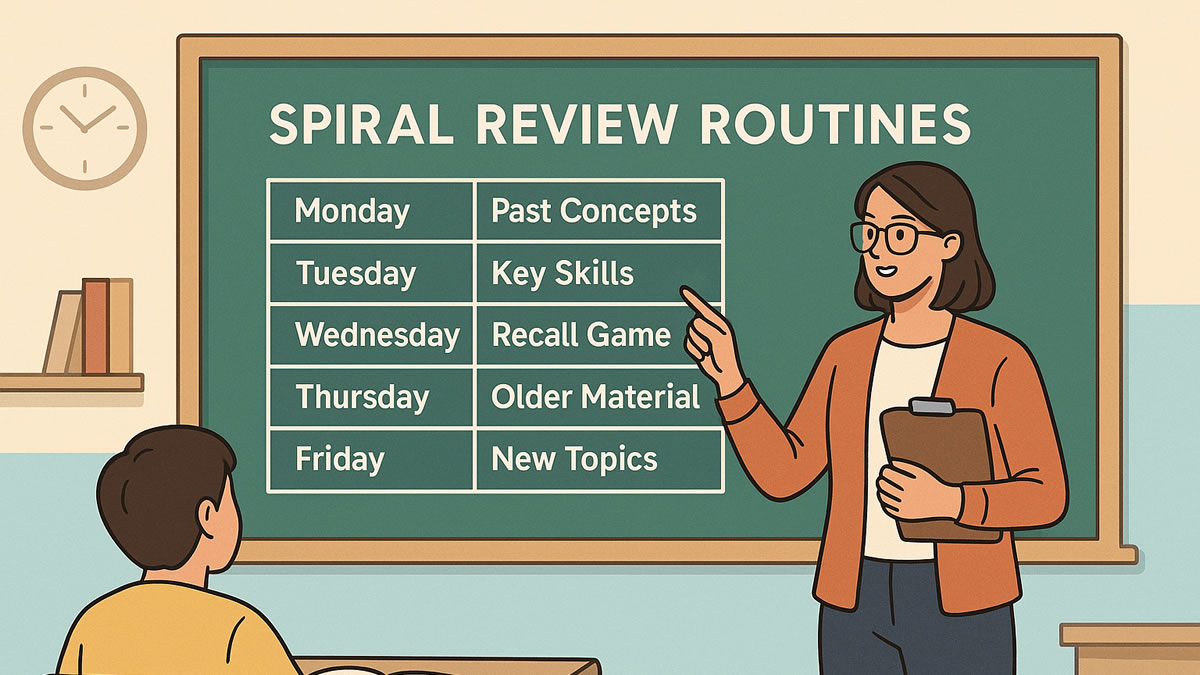
Run the same core words again a few days later, then swap out the words the class has clearly mastered. That small routine turns a one-time game into spaced review. For more ways to build spacing into your week, see spiral review routines.
8. Cumulative Word Duel
Once a month, run a longer game that pulls vocabulary from every unit so far, not just the current one.
Old words that students have not seen in weeks are exactly the words that need retrieval most. A cumulative game also shows students that vocabulary is not disposable, because words from September still appear in November.
Mixing old and new words in one activity adds interleaving, which makes practice feel harder in the moment but produces better long-term retention. Our guide to interleaving in classroom games covers how to structure the mix.
Writing Vocabulary Questions That Actually Test Understanding
The game format matters less than the questions inside it. Two guidelines improve almost any vocabulary question set.
Test the word in context, not just in isolation. Definition-matching has a place, but at least half of your questions should require students to apply the word: judge a usage, complete a sentence, or identify the word from a scenario.
Use distractors built from real confusions. If students mix up simile and metaphor, put both in the same question. A distractor no student would ever pick teaches you nothing about who understands the word.
Weak question:
What does abundant mean?
- plentiful B) purple C) frozen D) loud
Stronger question:
Which sentence uses abundant correctly?
- The harvest was abundant, so the town stored extra grain for winter.
- She felt abundant after losing the championship game.
- The abundant desert had almost no water for miles.
- He walked at an abundant pace to avoid being late.
For a full workflow on writing stems and distractors, including how to use AI to draft them faster, see Build Better Multiple-Choice Questions With AI.
To check what students can do with those words after practice, use these vocabulary assessment ideas. The worked examples distinguish recognizing a definition, interpreting a word in context, and using it independently, with a template for choosing what to teach next.
A Simple Weekly Vocabulary Routine
Games work best inside a routine that spaces practice across the week instead of stacking it the day before a quiz.
| Day | Activity | Time |
|---|---|---|
| Monday | Introduce 6 to 10 words with examples and student-friendly explanations | 10 min |
| Tuesday | Definition Detective or Picture Prompt as a bell ringer | 5 min |
| Wednesday | Context Clue Challenge with correct and incorrect usage | 5 min |
| Thursday | Lightning Round mixing this week's words with a few from past units | 8 min |
| Friday | Short game-based check, then review the most-missed words | 10 min |
The Friday step matters more than the quiz score. The two or three words most of the class missed are next week's review targets. If you use a game platform with question-level results, that list builds itself; see how to use question-level analytics to plan reteaching.
Vocabulary Games by Subject
The same game structures adapt across content areas.
| Subject | High-Value Vocabulary Targets | Best-Fit Games |
|---|---|---|
| ELA | Tone words, literary devices, academic verbs from writing prompts | Synonym Ladder, Context Clue Challenge |
| Science | Process terms, system components, commonly confused pairs | Odd One Out, Word Sort Relay |
| Math | Operation vocabulary, geometry terms, word-problem signal words | Definition Detective, Lightning Round |
| Social studies | Government structures, economic terms, era-specific vocabulary | Word Sort Relay, Cumulative Word Duel |
| World language | Theme vocabulary, false cognates, verb distinctions | Picture Prompt, Lightning Round |
| Elementary reading | Tier 2 words that appear across texts | Picture Prompt, Definition Detective |
In every subject, prioritize the words students will meet again: the academic vocabulary that shows up in directions, assessments, and future units. Marzano Resources' guidance on classroom vocabulary games makes the same point: games should reinforce the terms that matter most, not fill time.
How BrainFusion Supports Vocabulary Practice
BrainFusion turns a vocabulary list into playable review games in minutes.
Teachers can:
- Generate a draft question set from a prompt like "10 context-based questions for these 8th grade science terms," then edit before class
- Import an existing vocabulary list from CSV
- Reuse one question set across multiple game formats, including Quiz Quest, Ninja Fruit Frenzy, Helicopter Hangtime, Smart Shot, and Artifact Adventure
- Use Flashcard Fusion for individual practice, where an SM-2 spaced repetition algorithm resurfaces each word at the interval that fits how well a student knows it
- Run mixed sessions that interleave this week's words with earlier units
- Review question-level results afterward to see exactly which words and which wrong answers need attention
Students join live games with a short code and a name. No student accounts, no installation, and it works on Chromebooks, tablets, and phones.
Games do not replace rich vocabulary instruction, read-alouds, or wide reading. They replace the part of vocabulary practice that was always weakest: the worksheet.
Common Mistakes With Vocabulary Games
- Playing games only with definitions, never with usage or context
- Introducing words and testing them the same day, with no spacing
- Dropping words from rotation as soon as the unit ends
- Using distractors that no student would plausibly choose
- Letting the same few students answer every round instead of getting a response from everyone
- Treating the game score as the goal instead of reading which words the class missed
- Saving vocabulary review for the day before the test
Each of these is easy to fix, and fixing them costs no extra class time. The difference is in how the questions are written and when the words come back around.
Final Takeaway
Vocabulary sticks when students retrieve words repeatedly, in varied contexts, spread across weeks, with quick feedback on their misunderstandings. Games are simply the most reliable way to get students to do that willingly.
Start small. Take this week's word list, pick two of the games above, and slot them into your existing warmup or closing routine. Track the words students miss, bring those words back next week, and let the routine compound.
For more classroom game ideas and review routines, explore the classroom learning games topic guide.
Turn Your Word List Into a Game
Paste your vocabulary list or a prompt into BrainFusion, review the questions, and run a live game your students join with one code.