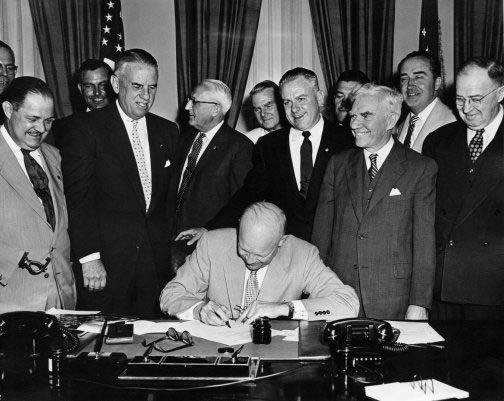
Show students the photograph above. Imagine it arrives at a museum with a caption that reads simply, President Eisenhower signs a law, June 1, 1954. What would a visitor still want to know?
Give your middle school class 25 minutes to write a better label. Their question is why did Congress change one word in the name of a holiday? Students will read the law that renamed Armistice Day and a proclamation explaining the change. By the end of class, each student will have written two sentences a museum visitor could understand.
Set up the 25-minute lesson
This lesson is designed for U.S. social studies or English language arts in grades 6–8. Project the signing photograph, print or display the two source cards below, and give each student a slip of paper for a label. Keep the teacher's answer key and sample label for the discussion after students write.
| Time | Classroom activity |
|---|---|
| 0–3 minutes | Show the photograph. Put Armistice Day and Veterans Day on the board. Ask students to predict what the new name might tell a visitor. |
| 3–10 minutes | Read Card A individually. Cross out the old word, write in its replacement, and circle the date the 1954 law kept. |
| 10–17 minutes | Read Card B with a partner. Underline the words that tell you whom the observance would honor. Explain your choice to each other. |
| 17–20 minutes | Use the three questions below for a quick check. Students can respond on paper or play a short classroom review game. |
| 20–25 minutes | Students write their museum labels independently. Collect them as the exit ticket. |
Introduce one word before the first reading. An armistice is an agreement to stop fighting. The armistice between the Allies and Germany took effect on November 11, 1918. The date helps explain why the United States observed Armistice Day on November 11. U.S. Department of Veterans Affairs history of Veterans Day
Two primary source cards to copy for students
Card A. Congress edits the name of a holiday
Public Law 83-380, approved June 1, 1954. An earlier law had made November 11 a legal holiday called Armistice Day. In 1954, Congress amended that law with this instruction:
“by striking out the word ‘Armistice’ and inserting in lieu thereof the word ‘Veterans’.”
In lieu thereof means in its place. On your paper, write the old name of the holiday and make the edit yourself. Beside it, write the month and day of the holiday under the amended law.
On the original page, find Public Law 380 near the middle. Read its short title and the sentence beneath it. Read the law in the U.S. Statutes at Large, page 168
Card B. Eisenhower explains the wider observance
Presidential Proclamation 3071, October 8, 1954. President Eisenhower recalled the Americans who had served in World War I. Millions more had since served in World War II and the Korean War. He described Congress's purpose in broadening the observance:
“in order that a grateful Nation might pay appropriate homage to the veterans of all its wars”
Pay homage means show respect. Which words tell you how far that respect extends? Try a concrete case with your partner. A U.S. veteran served in Korea in 1952. Which words would help you explain why the November 1954 observance included that person?
In the original document, find the paragraph that mentions the act approved June 1. The next paragraph tells readers how Eisenhower asked Americans to observe November 11 that year. Read Eisenhower's Veterans Day proclamation
Three ready-to-copy review questions
- Which edit did Congress make in 1954? A. Change November to October. B. Replace Armistice with Veterans. C. Replace Veterans with Armistice.
- On which date did Eisenhower ask Americans to observe Veterans Day in 1954? A. June 1. B. October 8. C. November 11.
- Which group fits the purpose Eisenhower described? A. U.S. veterans across the country's wars. B. Only Americans who served in World War I. C. Only veterans who attended the signing ceremony.
Teacher's answer key. 1 B, the law replaced one word in the name. 2 C, June 1 was the law's approval date, October 8 was the proclamation date, and November 11 was the observance. 3 A, the proclamation extends recognition across wars. If the class splits on question 2, ask three students to pair each date with a verb on the board: approved, proclaimed, or observed.
To use these questions in BrainFusion, create a short review game and enter the three items with the answers above. Keep the source cards available when students return to their own writing.
Write and assess the museum label
Student prompt. Write two sentences to accompany the signing photograph. In your first sentence, tell a visitor what Congress changed and when the holiday was observed. In your second, explain why the new name mattered. Use one detail from each card. You can put the ideas in your own words.
Sample museum label
In 1954, Congress renamed the November 11 holiday from Armistice Day to Veterans Day. Eisenhower explained that Americans could use the day to honor people who had served across the nation's wars, including veterans of World War II and Korea.
The first sentence uses the document Eisenhower is signing in the photograph. It identifies the edit and anchors the visitor to November 11. The second uses the later proclamation to explain the edit's significance. Students can underline their detail from the law and draw a box around their detail from the proclamation as a final check.
When you read the labels, look for the name change, the November date, and an explanation of the wider group being honored. A student who writes “Congress wanted to thank veterans” has identified a purpose. Ask that student to name someone included in the 1954 observance who served after World War I, then use that example to sharpen the label.
For another version of this writing check, see our guide to classroom exit tickets. For a longer social studies lesson that also pairs source work with discussion, see our MLK Day lesson ideas.
Featured photograph courtesy of the Dwight D. Eisenhower Presidential Library and Museum. Public-domain photograph and archival credit