To address area and perimeter misconceptions, ask students to measure two things on the same rectangle: the distance around its boundary and the space it covers. Then compare rectangles with the same area but different perimeters, and reverse the comparison. Have students explain what stayed equal before giving them another formula exercise.
This lesson is for a grade 4 teacher or elementary math tutor whose students remember “add” and “multiply” but still choose the wrong measurement. It includes an original garden-planning task, four checked questions, and an individual exit task. Use it after students have worked with rectangular arrays and counting boundary lengths.
What should students distinguish?
Perimeter is the length around a shape's boundary. Area measures the space covered by the shape. For a rectangle measured in meters, perimeter is expressed in meters (m) and area in square meters (m²).
The Virginia Department of Education's remediation plan identifies several instructional targets: swapping the formulas, confusing the units, and adding length and width when finding area. A correct calculation alone may leave one of those distinctions unresolved.
There is another idea to probe: “If two gardens have equal area, they need equal amounts of fencing.” The Utah measurement guide, page 9, explicitly includes rectangles with equal areas and different perimeters, and the reverse. The comparison builds on grade 3 measurement work and can support grade 4 reteaching; match it to your local curriculum.
Keep the lesson goal visible:
I can distinguish covering a garden from fencing its boundary, and use a rectangle to explain why equal area does not guarantee equal perimeter.
Draw two gardens with the same area
Present this fictional planning problem:
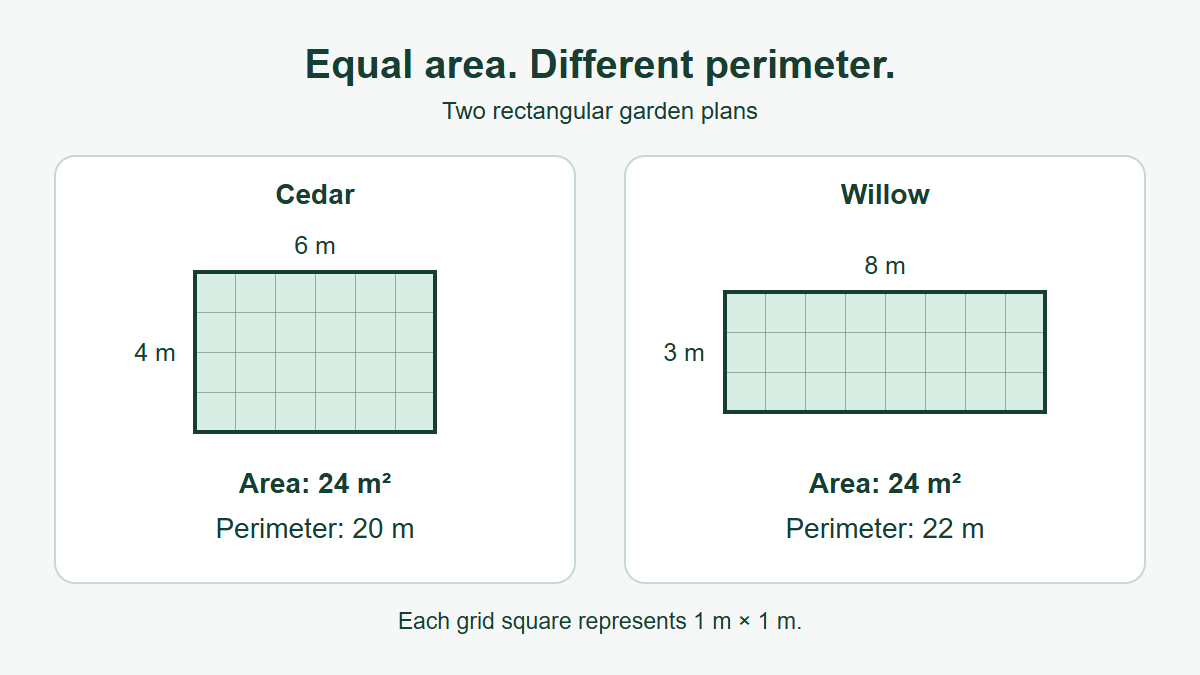
A school is comparing rectangular garden plans. Plan Cedar is 6 m long and 4 m wide. Plan Willow is 8 m long and 3 m wide. Both need soil over the entire surface and fencing along all four sides. Ignore gates, fence thickness, and extra material for installation.
Before revealing the results, ask: “Would these plans need the same amount of soil coverage? Would they need the same length of fencing?” Collect predictions separately so “same” does not stand in for both quantities.
Draw each rectangle on a square grid, with every square representing 1 m by 1 m. Keep the grid scale equal across both drawings. Shade the covered squares and trace the outside boundary with a finger or pencil. Labels should identify the two measurements even when the drawing is viewed without color.
| Garden plan | Area | Perimeter |
|---|---|---|
| Cedar: 6 m × 4 m | 6 × 4 = 24 m² | 6 + 4 + 6 + 4 = 20 m |
| Willow: 8 m × 3 m | 8 × 3 = 24 m² | 8 + 3 + 8 + 3 = 22 m |
The soil coverage is equal: each plan covers 24 one-square-meter spaces. Willow needs 2 m more fencing because its boundary is longer. Neither statement requires one garden to be “bigger” in every sense.
Connect the model to area = length × width and perimeter = length + width + length + width. Introduce P = 2 × (length + width) as another way to count the same four sides once students can explain what is being doubled.
Avoid drawing a 4 m by 4 m square as your only introductory example. Its area is 16 m² and its perimeter is 16 m. Equal numerical values can conceal confusion between quantities with different units.
Use four questions to locate the difficulty
These questions are original teaching examples. Keep the explanations in your teacher notes until students have responded. Ask learners to sketch, point, or explain alongside their selected answer when you need to understand their reasoning.
1. Which measurement buys the fencing?
Cedar is 6 m long and 4 m wide. How much fencing is needed along all four sides, with no gate?
A. 10 m
B. 20 m
C. 24 m
Answer: B, 20 m. Add 6 + 4 + 6 + 4. A counts only one length and one width. C uses the number from multiplying the side lengths, which calculates the area rather than the boundary length.
Ask a learner who chooses A to trace a complete trip around the rectangle. Ask one who chooses C to show where each meter of fence would go. Those prompts investigate possible reasoning; the chosen letter does not establish a diagnosis.
2. Which statement compares the two plans correctly?
Cedar is 6 m by 4 m. Willow is 8 m by 3 m. Which statement is correct?
A. They cover equal areas, but Willow has a longer perimeter.
B. They cover equal areas, so their perimeters must be equal.
C. Willow covers a greater area because its longest side is longer.
Answer: A. Both products are 24 m². Their perimeters are 20 m and 22 m. The longer single side does not determine either the full boundary length or the covered space by itself.
If a learner chooses B, ask them to compare the traced boundaries while keeping both grids visible. If they choose C, ask them to count the complete rows of squares. Calculation errors and the belief that “longer means more area” need different follow-up.
3. Can equal fencing enclose different areas?
Two new rectangular plans measure 2 m by 10 m and 4 m by 8 m. Which statement is correct?
A. Both have a perimeter of 24 m and an area of 24 m².
B. The 2 m by 10 m plan has both the greater perimeter and the greater area.
C. Both have a perimeter of 24 m, but their areas are 20 m² and 32 m².
Answer: C. The boundaries are 2 + 10 + 2 + 10 = 24 m and 4 + 8 + 4 + 8 = 24 m. Their covered spaces are 2 × 10 = 20 m² and 4 × 8 = 32 m².
This reverses the earlier comparison. Equal boundary length does not guarantee equal area. Ask students to draw the rectangles on the same grid scale before accepting “they look different” as the whole explanation.
4. Which record uses the right quantities and units?
A rectangular garden is 7 m long and 3 m wide. Which record is correct?
A. Area: 20 m². Perimeter: 21 m.
B. Area: 21 m². Perimeter: 20 m.
C. Area: 21 m. Perimeter: 20 m².
Answer: B. The garden covers 7 × 3 = 21 square meters. Its boundary is 7 + 3 + 7 + 3 = 20 meters. A swaps the calculations; C keeps the numbers but swaps the units.
Ask students to complete two sentences: “One meter measures ___” and “One square meter covers ___.” Correct numbers with reversed units call for a different explanation from incorrect multiplication.
Match the next teaching move to the explanation
The NCETM discussion of perimeter and area emphasizes reasoning about shapes as well as calculating. Its examples address older pupils, but the distinction is useful here: students should be able to describe the boundary and covered space in their own model.
| What you observe | What to ask or show next |
|---|---|
| Adds only length and width | Trace all four sides and record each length before adding. |
| Multiplies when asked for fencing | Place line segments around the edge, then contrast them with squares covering the inside. |
| Says equal area means equal perimeter | Rebuild Cedar and Willow with 24 equal squares; trace each outer boundary. |
| Gives correct numbers but swaps m and m² | Compare a one-meter line with a one-square-meter region. Ask what each unit measures. |
| Explains correctly but miscalculates | Keep the model and address the arithmetic separately. |
| Selects correct choices but cannot explain | Give a fresh rectangle and ask for a labeled sketch before offering choices. |
Use the rows as hypotheses to investigate. Check unclear wording, missed participation, reading demands, or device controls before interpreting a response as a mathematical difficulty.
For language support, offer “The boundary measures ___ meters” and “The garden covers ___ square meters.” Students can point to the model or explain orally while retaining the mathematical terms. Collect an individual response even if partners build the drawings together.
Finish with a changed-number exit task
Use this prompt without the worked table in view:
A 5 m by 4 m garden and a 10 m by 2 m garden each need fencing around all four sides. Compare their areas and perimeters. Explain whether equal soil coverage guarantees equal fencing length.
Model response: Both cover 20 m² because 5 × 4 = 20 and 10 × 2 = 20. The first perimeter is 18 m; the second is 24 m. Equal soil coverage does not guarantee equal fencing length.
Ask for a labeled sketch or explanation, not just four numbers. If the student repeats the rule but cannot connect it to the rectangles, return to the grid model. If the model is sound but one sum is wrong, focus the feedback on that calculation.
For a suggested 25-minute lesson, allow about 5 minutes for predictions and drawings, 7 for modeling, 8 for selected questions and discussion, and 5 for the exit task. Adjust the timing and question count for your learners. This is a planning option, not an established optimal schedule.
AERO's Monitor progress guide supports checking understanding and providing further instruction or feedback. It does not validate this particular lesson sequence. Our exit-ticket guide explains how to use the final response to plan the next lesson.
Where BrainFusion can support the practice
After modeling the rectangles, enter reviewed questions manually or import them by CSV into BrainFusion. Quiz Quest offers focused multiple-choice practice with immediate correctness feedback. Keep the garden drawings visible on a slide or handout where students can inspect them while answering.
For recorded classroom results, create a scored session and share its joining details. Learners join in the browser without learner accounts; the creator needs an account. Review the session's question-level results and missed-question view, then ask for the explanations needed to interpret them. The question-level reteaching guide describes that follow-up process.
Keep drawings and extended explanations outside the game. A selected answer does not automatically reveal a misconception, and an improved replay score does not establish lasting understanding. The formative assessment guide explains how to connect a check with a teaching decision.
If device access or joining time would displace the modeling, present the same questions on a slide and collect individual written answers. The mathematical comparison is the lesson's core.
Two clarifications teachers may need
Should students count boundary squares?
Count unit-length edges on the outside, not the squares touching the boundary. A corner square can contribute two outside edges. Edges shared by neighboring squares are inside the shape and do not contribute to its perimeter. Ask students to trace one continuous path to make the counting visible.
Should students find the largest possible garden?
That is a useful extension after they can separate the two measurements. Begin with whole-number rectangular plans using 24 m of fencing: 1 × 11, 2 × 10, 3 × 9, 4 × 8, 5 × 7, and 6 × 6 meters. Each perimeter is 24 m; the areas are 11, 20, 27, 32, 35, and 36 m². Among these plans, the 6 m square covers the most space. Keep that bounded comparison separate from a proof about every possible shape.
Prepare one comparison for your next lesson
Draw Cedar and Willow at the same scale, choose the questions that match your students' needs, and decide which model you will use after each response. Save the changed-number task for an individual check.
Create a BrainFusion practice set when the questions are ready, or inspect the free sample activities to explore the question-and-explanation format first. Public sample responses are not saved as classroom session reports.
Sources and method
BrainFusion publishes this lesson. The garden names, numerical task set, answer explanations, response table, and timing are original planning suggestions, not results from a classroom trial. Mathematics, source support, and product behavior were reviewed November 22, 2026.
- Virginia Department of Education: Finding Area and Perimeter, page 1, for formula and unit confusions to investigate.
- Utah State Board of Education: Grade 3 Measurement and Data guide, pages 5–9, for square units, rectangle models, and equal-area/equal-perimeter comparisons.
- NCETM: Teaching perimeter and area using Checkpoints, for conceptual and spatial explanation alongside calculation.
- AERO: Monitor progress, for checks that inform additional instruction and feedback.