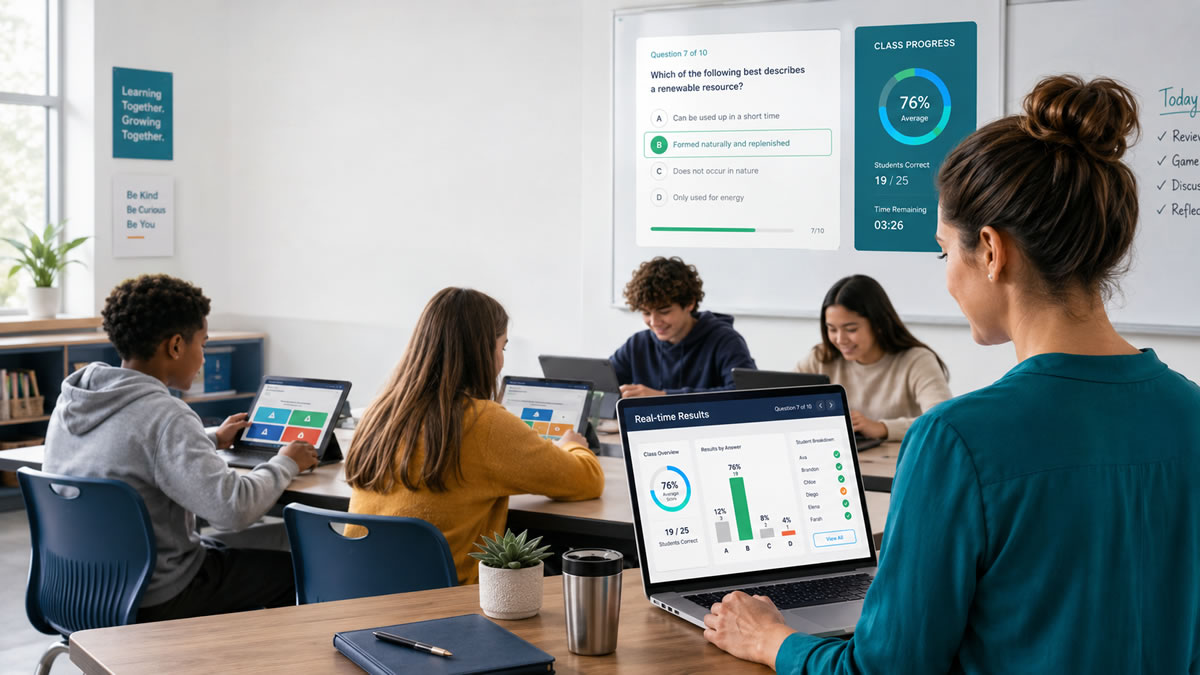
The best first week of school games do more than fill time between introductions and the syllabus. They help students learn how your classroom works, make it safer to participate, and give you an early look at what the class already knows.
That combination matters. A game that is only social can feel forced, especially to shy or anxious students. A game that is only academic can feel like a surprise test. The seven activities below keep the stakes low while giving every round a clear purpose.
Quick Answer
Good first week of school games are short, inclusive, easy to explain, and useful beyond the moment. Choose games that let students collaborate without requiring personal disclosure, then add a low-pressure academic check so you can plan what to teach next.
Why Community and Learning Belong in the Same Activity
Students are asked to take small academic risks all day: answer before they are certain, explain an unfinished idea, ask for help, and let classmates see a mistake. Those risks become easier when the classroom already feels supportive.
In Helping Students Collaborate and Connect From Day One, published July 20, 2026, Edutopia teacher-contributor Maggie Espinola describes using interactive routines and low-stakes group challenges to reduce anxiety and prepare students for later collaboration. The central idea is simple: comfort and connection come before high-stakes group work.
School connectedness has value beyond the first week. The CDC defines connectedness as students feeling supported and respected by peers and adults, and notes that peer connection is associated with greater engagement in school.
But community building does not require abandoning the curriculum for five days. A well-designed game can also help you:
- Learn names, interests, and group dynamics
- Model how students should discuss disagreement
- Rehearse procedures in context
- Surface prior knowledge and misconceptions
- Show that mistakes lead to feedback, not embarrassment
- Decide which concepts need review before a new unit begins
The goal is not to manufacture instant friendship. It is to make participation feel normal, safe, and worthwhile.
1. Classroom Quest
Turn your syllabus and classroom procedures into a team scavenger hunt.
Create 10 to 12 prompts that require students to find, interpret, or apply important information. Avoid questions that reward fast copying. Ask students to make a decision with the information instead.
Examples:
- Where should you look if you are absent and need the assignment?
- What are two ways to ask for help during independent work?
- Which materials should be ready before the bell?
- A project is due Friday, but you know on Tuesday that you need support. What should you do?
- Which class norm would help a group resolve a disagreement?
Put students in pairs or groups of three. Give each group one answer sheet and require a different person to record each response. Finish with a whole-class debrief instead of simply announcing a winner.
What you learn: Who reads carefully, who asks clarifying questions, who organizes the group, and which procedures need another explanation.
Best for: Grades 4 through 12 | Time: 15 to 20 minutes
2. Common Ground Grid
Traditional icebreakers often ask students to perform on command: share an unusual fact, describe an embarrassing moment, or speak alone in front of strangers. Common Ground Grid shifts the task from individual performance to shared discovery.
Give each group a blank 3-by-3 grid. Students fill the squares with nine things everyone in the group has in common. Set boundaries before they begin: answers should be school-appropriate, no one has to share private information, and physical traits do not count.
Encourage students to move beyond obvious answers such as "we attend the same school." They might discover that everyone likes graphic novels, has learned something from a video, prefers working with music, or wants to improve at public speaking.
At the end, each group chooses one square to share. Do not require every student to speak yet. The point is to create a first successful conversation, not to test public-speaking confidence.
What you learn: Student interests, natural conversation patterns, and who may need a more structured entry into group work.
Best for: Grades 3 through 12 | Time: 10 to 15 minutes
3. Choose a Side
Post two choices on opposite sides of the room. Students move to the side that fits their answer, talk with one nearby person, and then hear two or three volunteers explain their choice.
Start with low-risk prompts:
- Read the book or watch the movie?
- Work with music or in silence?
- Explore the ocean or explore space?
- Solve one hard problem or five quick problems?
Then add prompts that quietly introduce learning preferences and classroom habits:
- See an example first or try it first?
- Explain your thinking aloud or write it down?
- Review alone first or start with a partner?
- Get feedback during the work or after finishing a draft?
Make the middle of the room a valid answer. Students should be able to choose "it depends" without defending personal information. You can also let students change sides after hearing a persuasive explanation, which models the idea that changing your mind is part of learning.
What you learn: Preferences that can inform future directions, grouping, examples, and response options.
Best for: Grades 2 through 12 | Time: 8 to 12 minutes
4. Procedure Remix
Students remember procedures better when they apply them to realistic situations instead of hearing a list.
Give each team a classroom scenario with one or two things going wrong:
The bell rings. One student is sharpening a pencil, another is asking what page to open, and the warmup is already on the board. What should the group do differently tomorrow?
Other scenarios can cover transitions, technology, group roles, requesting help, turning in work, or leaving the room. Teams get two minutes to identify the problem and propose a better routine. They can explain the fix, sketch it, or act it out.
Keep the tone constructive. The activity is about designing a classroom that works, not catching students breaking rules.
After each response, name the reason behind the routine. "Open the warmup before sharpening a pencil" feels arbitrary. "Starting immediately protects learning time and helps everyone settle" gives the procedure a purpose.
What you learn: Which directions are clear, which routines students can transfer to a new situation, and where your expectations contain hidden assumptions.
Best for: Grades 3 through 12 | Time: 15 minutes
5. Concept Sort Relay
Now move from community and procedures into academic thinking.
Choose 12 to 20 words, images, examples, or problems connected to the first unit. Include a mix of:
- Ideas students should already know
- Ideas they may partially remember
- Two or three items that commonly get confused
- One item that could fit more than one category
Teams sort the cards under category headings, then choose one placement they found difficult and explain their reasoning. Skip the speed element if it would make students rush past the discussion. "Relay" can mean rotating which student places and explains each card, not racing another group.
Examples:
- Science: living, nonliving, or once living
- Math: proportional or nonproportional relationships
- ELA: claim, evidence, or reasoning
- Social studies: political, economic, or social causes
- World language: noun, verb, adjective, or phrase
The debatable card is especially useful. It lets you model how the class should disagree: point to evidence, listen, revise, and separate the quality of an idea from the person who offered it.
What you learn: Vocabulary gaps, category knowledge, common confusions, and how students explain their thinking.
Best for: Grades 3 through 12 | Time: 12 to 18 minutes
6. Find the Misconception
Write four statements about a prerequisite concept. Three are accurate and one reflects a common misunderstanding. Teams identify the misconception and rewrite it.
For example:
Which statement needs to be corrected?
A digit's value depends on its place.
Multiplying a whole number by 10 shifts each digit one place to the left.
A zero in a number can act as a placeholder.
Multiplying any number by 10 means writing a zero at the end.
Statement D works for many whole numbers, but it breaks down with decimals. A student who chooses it and explains why gives you much more information than a student who answers a basic multiplication fact.
Have teams reveal answers at the same time so the fastest group does not control everyone else's thinking. Ask for reasoning before confirming the answer.
This game is diagnostic, not graded. The Australian Education Research Organisation's formative assessment guide recommends informal pre-quizzes to identify what students already know or think they know before a unit begins.
What you learn: Whether students can distinguish a reliable rule from an overgeneralization, and which misconceptions should shape your first lessons.
Best for: Grades 4 through 12 | Time: 10 to 15 minutes
7. Five-Question Knowledge Sprint
End the week with five carefully chosen questions from last year's essential learning. Keep it short enough to feel like a game and focused enough to guide next week's planning.
A useful five-question set includes:
- One foundational fact or definition
- One application in a familiar context
- One common misconception
- One question that connects two ideas
- One transfer question in a new context
Tell students what the results are for: "This will help me decide what we can move through quickly and what deserves a refresher." Do not attach a grade or use the leaderboard as evidence of ability.
If you run the sprint digitally, review results by question rather than looking only at total scores. A class average of 70 percent tells you very little. Knowing that most students missed the transfer question but understood the foundation tells you exactly what to plan.
What you learn: Classwide strengths, specific misconceptions, and the difference between recognition and application.
Best for: Grades 3 through 12 | Time: 8 to 12 minutes
A Simple First-Week Schedule
You do not need to run all seven first week of school games. Choose one community activity, one procedure activity, and one academic check, then leave room for real instruction.
| Day | Game | Purpose | Follow-Up |
|---|---|---|---|
| Monday | Common Ground Grid | Make the first peer conversation low-risk | Note students who may need structured group roles |
| Tuesday | Classroom Quest | Learn routines by applying them | Clarify the two most-missed procedures |
| Wednesday | Choose a Side | Practice listening and respectful disagreement | Reuse the discussion routine during a lesson |
| Thursday | Concept Sort Relay | Surface prior knowledge collaboratively | Save uncertain cards for a mini-lesson |
| Friday | Five-Question Knowledge Sprint | Identify strengths and misconceptions | Plan next week's review from question-level results |
The follow-up column is what turns an activity into a classroom system. If students practice a discussion routine on Wednesday, use the same routine during content on Thursday. If Friday's results reveal a gap, show students on Monday how the class will address it.
How to Keep First-Week Games Inclusive
A game can lower anxiety, but only if its design does not create a new source of pressure.
Use these guardrails:
- Allow a pass. Students should not have to reveal family details, birthdays, health information, or experiences to participate.
- Avoid elimination. A student who is out first loses the exact practice and connection the activity was meant to provide.
- Use simultaneous responses. Mini whiteboards, cards, or digital answers let every student think before one voice takes over.
- Reward reasoning, not just speed. Fast recall is not the same as deep understanding.
- Keep teams small. Groups of three or four make it harder for a student to disappear.
- Rotate visible roles. Reader, recorder, materials manager, and reporter give participation a structure.
- Do not grade the diagnostic round. Students are more likely to expose confusion when the cost of being wrong is low.
- Debrief the process. Ask what helped the team listen, decide, or recover from a mistake.
The first week teaches students what your classroom rewards. Make sure the answer is curiosity, effort, explanation, and support for one another.
Turn a First-Week Question Set Into a BrainFusion Game
BrainFusion can handle the digital parts of this plan without requiring student accounts or an installation.
Teachers can:
- Create questions manually, import a CSV, or use AI to draft a set for review
- Edit every question and answer before students see it
- Reuse one question set across the available game formats
- Start a live session that students join with a short code and a name
- See question-level results after the game, including which wrong answers students chose
- Reuse the same set later to check whether a misconception has changed
For the first week, keep the content modest. A five- to eight-question game is enough. Try a mix of classroom routines, low-risk teacher trivia, and prerequisite concepts.
One caution: AI can accelerate a first draft, but it does not know your students, local curriculum, or classroom norms. Check the reading level, verify the answer key, remove ambiguous wording, and replace generic questions with the misconceptions you actually expect.
For more question-writing guidance, see Build Better Multiple-Choice Questions With AI. If you want to carry the routine into the rest of the year, use these game-based bell ringers.
What to Do With What You Learn
Do not collect first-week information unless you plan to use it.
After each activity, make one small instructional decision:
- Reteach a procedure with a clearer example
- Adjust a seating or grouping choice
- Add a written response option before discussion
- Review one prerequisite concept
- Replace an easy introductory lesson with a more challenging task
- Save a common misconception for next week's warmup
Tell students when their responses changed your plan. "Many of you understood equivalent fractions, so we are moving ahead. The comparison question was harder, so we will start there tomorrow." That sentence shows that participation has a purpose and that assessment is something teachers use to support learning, not merely score it.
For a deeper workflow, read how to use question-level analytics to plan reteaching.
Final Takeaway
The first week of school should not be five days of forced icebreakers or five days of rules. It should give students repeated evidence that they can participate, make mistakes, work with different classmates, and learn something useful about how the class operates.
Start with three games: one for connection, one for procedures, and one for prior knowledge. Keep the stakes low, pay attention to what students show you, and let the next lesson prove that you were listening.
Create Your First-Week Game
Add a short question set, choose a game, and let students join with one code. Review the results to plan what comes next.