To teach mass vs. weight in middle school, keep the object unchanged and change its location. Ask students to predict what happens to its mass and gravitational weight when it moves from Earth's surface to the Moon's surface. Collect an explanation as well as an answer, then use a new object to check the idea again.
This lesson is for a grades 6–8 science teacher or tutor whose students can repeat the definitions but still use the terms interchangeably. It includes a worked equipment-case example, three conceptual questions, an optional calculation, and follow-up teaching moves. You can teach it with a projected slide and individual responses or use a reviewed digital question set.
Establish the distinction before introducing calculations
For this lesson, mass describes how much matter an object contains, measured in kilograms (kg). Weight means the gravitational force acting on that object, measured in newtons (N). Moving an unchanged object between the surfaces of Earth and the Moon changes its weight while leaving its mass the same. NASA's Mass vs. Weight teaching introduction explains this distinction and the Moon's weaker gravitational pull.
The Institute of Physics identifies treating mass and weight as alternative words for the same property as a misconception worth probing. A student who says “It gets lighter” may understand the situation, but that sentence alone leaves the scientific meaning unclear. Ask which quantity changes and why.
Use this original model throughout the lesson:
A sealed equipment case has a mass of 5 kg. It is transported from Earth's surface to the Moon's surface. Nothing is added or removed. For our calculations, use a gravitational field strength of 10 N/kg on Earth and 1.6 N/kg on the Moon.
These are rounded classroom values. Earth's familiar value is about 9.8 N/kg; the rounded value keeps arithmetic manageable. OpenStax's mass and weight explanation gives the corresponding Earth and Moon values. NASA describes lunar weight as roughly one sixth of Earth weight. Our numbers are a simplified model, not precision measurements.
| Property | Earth | Moon |
|---|---|---|
| Mass (kg) | 5 | 5 |
| Field strength (N/kg) | 10 | 1.6 |
| Weight (N) | 50 | 8 |
The case contains the same matter in both locations. Each kilogram experiences a smaller gravitational force on the Moon.
Write weight = mass × gravitational field strength, or W = mg. For the case, 5 kg × 10 N/kg = 50 N on Earth; 5 kg × 1.6 N/kg = 8 N on the Moon. The kg units cancel, leaving N. Give the table after students make their initial prediction if you want to hear their starting ideas.
Use a suggested 20-minute lesson sequence
The timing below is a planning suggestion. Adjust it for reading, discussion, device access, and students' prior instruction. If joining a digital activity takes longer, shorten the question set rather than removing the explanation time.
- Predict, 3 minutes. Present the unchanged case and Question 1 below. Ask everyone to choose privately and finish: “Its mass ___ because ___; its weight ___ because ___.”
- Model, 5 minutes. Reveal the table. Point to what stayed constant and what changed. Work through the multiplication if students are ready for it.
- Check, 5 minutes. Use Questions 2 and 3. Collect individual answers before partners discuss. Ask students to explain one choice aloud, in writing, or through an annotated diagram.
- Respond, 4 minutes. Use the response table below to choose another explanation. Students revise their original sentence.
- Transfer, 3 minutes. Give the changed-object exit question without the worked table in view.
This sequence follows the general principle of checking understanding and responding during instruction. AERO's Monitor progress guide recommends using checks to guide additional instruction and feedback. It does not validate this particular schedule or question set.
For learners who need language support, retain the scientific terms while offering “The amount of matter stays ___” and “The gravitational pull becomes ___.” Read prompts aloud when appropriate. A partner answer can support discussion; collect an individual explanation before interpreting it as evidence about each learner.
Copy these mass-versus-weight questions
These are original teaching examples. Keep the answer explanations in your teacher notes when presenting the questions independently.
Question 1: What changes on the Moon?
The unchanged 5 kg equipment case moves from Earth's surface to the Moon's surface. Which statement is correct?
A. Its mass decreases and its weight decreases.
B. Its mass stays the same and its weight decreases.
C. Its mass stays the same and its weight stays the same.
Answer: B. The case still contains the same matter. The Moon exerts a smaller gravitational force on it, so its weight decreases.
If a student chooses A, ask, “What material left the case during the journey?” If they choose C, ask, “Would the same amount of matter experience the same gravitational pull at both surfaces?” These are probes of possible reasoning, not diagnoses established by the selected letter.
Question 2: What does 8 N describe?
Using our classroom values, the case has a mass of 5 kg and a weight of 8 N on the Moon. What does 8 N describe?
A. The amount of matter inside the case.
B. The gravitational field strength at the case.
C. The gravitational force acting on the case.
Answer: C. Newtons measure force. The mass is 5 kg; the gravitational field strength in this model is 1.6 N/kg. Distinguishing N from N/kg helps students separate the resulting force from the multiplier used to calculate it.
If the class is not using N/kg yet, replace B with “The volume occupied by the case” and keep the focus on mass versus force.
Question 3: What happens when we add material?
While the case remains on the Moon's surface, an astronaut adds a 1 kg tool. Its total mass becomes 6 kg. Which statement is correct?
A. Its mass increases and its weight increases.
B. Its mass increases and its weight stays the same.
C. Its mass stays the same and its weight increases.
Answer: A. Adding the tool adds matter. At the same location, the greater mass also experiences a greater gravitational force. With our values, its weight becomes 6 × 1.6 = 9.6 N.
This question changes a different variable. “Mass stays the same” applies to the unchanged object moving between locations; it does not mean that adding material can never change mass.
Optional calculation: Can students use the relationship?
A different sealed kit has a mass of 3 kg. Using 10 N/kg on Earth and 1.6 N/kg on the Moon, what are its weights?
A. Earth: 30 N; Moon: 30 N.
B. Earth: 30 N; Moon: 4.8 N.
C. Earth: 3 N; Moon: 0.48 N.
Answer: B. Earth: 3 × 10 = 30 N. Moon: 3 × 1.6 = 4.8 N. In both locations its mass remains 3 kg.
Use this item only after teaching the calculation. If a learner explains the concept correctly but multiplies incorrectly, address the arithmetic separately before deciding the concept needs reteaching.
Match the next explanation to the response
| What you hear or see | What to check | A useful teaching move |
|---|---|---|
| “Both decrease because the Moon has less gravity.” | Does the learner think matter disappears? | Draw the same case contents twice, then use different-length arrows for gravitational force. |
| “Neither changes because it is the same case.” | Are mass and force being treated as the same quantity? | Keep 5 kg fixed and compare 10 N/kg with 1.6 N/kg before multiplying. |
| “Mass never changes, even when we add the tool.” | Has the learner overgeneralized the location rule? | Contrast moving the sealed case with adding material to it. |
| Correct choices, unclear explanations | Could guessing or remembered answer letters explain the result? | Ask for a new prediction with the locations reversed. |
| Missing answers or unusually slow responses | Did reading, controls, or access interfere? | Collect a spoken, written, or diagram response before judging understanding. |
Use these as hypotheses to investigate. One choice, one gameplay score, or an improved replay does not demonstrate complete understanding or lasting retention. Our formative assessment guide explains the broader evidence-and-follow-up process.
For the exit question, ask: “An unchanged 2 kg sample moves from the Moon's surface to Earth's surface. What happens to its mass and weight? Explain without calculating.” The mass remains 2 kg and the weight increases because Earth's surface gravitational field is stronger. This reverses the journey without repeating the original answer pattern.
Where BrainFusion fits in the lesson
Use BrainFusion for reviewed question practice alongside the teacher-led model and explanations. Create the set manually or import questions through CSV. Check every answer key, unit, and choice before sharing it. If you use AI to draft additional examples, review them against the source and learning target; our question-writing guide provides a review process.
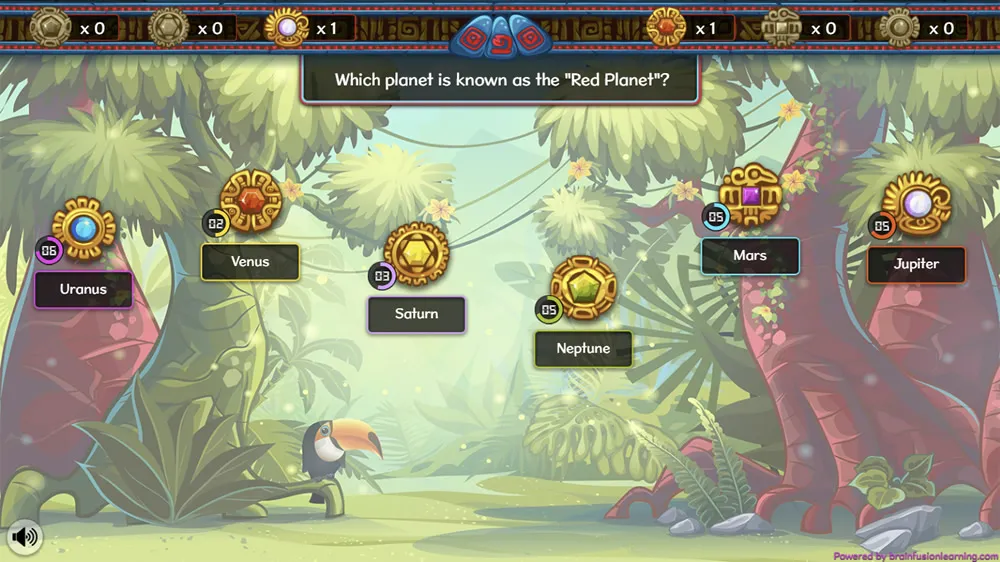
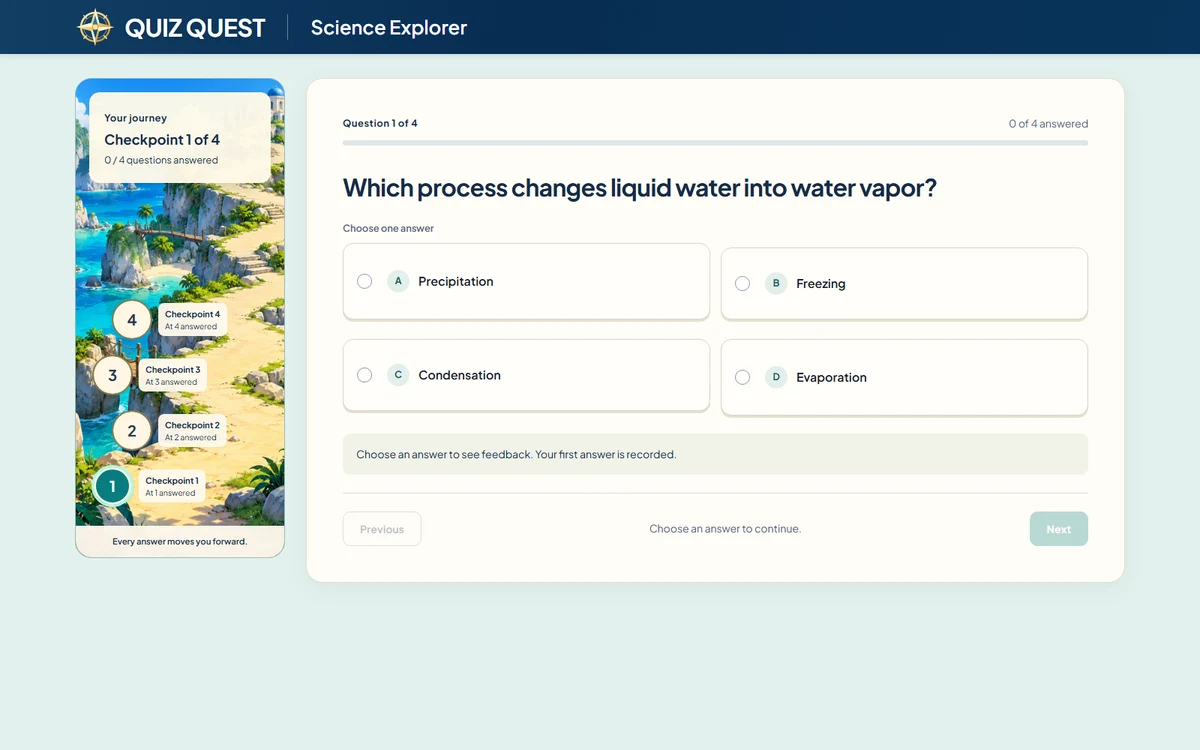
Quiz Quest presents questions with answer choices and immediate feedback. The featured image is an existing water-cycle practice example, showing the question format rather than this mass-versus-weight set. Preview your own set and its controls before the lesson. Keep extended explanations and the final individual response outside the game when that makes students' reasoning easier to see.
You can also present the same questions on a slide and use individual written responses. Choose the delivery method that gives every learner a reasonable chance to explain the science.
Questions teachers may need to clarify
Why do students call kilograms their weight?
Everyday language often uses “weight” when it means mass, as NIST's mass-versus-weight explanation discusses. That familiar label can blur the distinction. In this lesson, label the quantity explicitly: mass in kg, gravitational weight in N. If students ask about a particular scale, distinguish the quantity it displays from how its mechanism works before drawing conclusions about using it on the Moon.
Should I include astronauts floating in orbit?
Keep the surface-to-surface comparison first. Floating in orbit introduces apparent weightlessness and free fall, which can distract from the initial distinction. NASA explains that the astronaut, spacecraft, and objects fall together; floating does not mean Earth has stopped exerting gravity. Add that discussion when students are ready to separate gravitational force from a scale reading.
Prepare one focused science check
Copy the three conceptual questions, verify the language against your curriculum, and plan which explanation you will use after each likely response. Use the changed-object question as an individual exit ticket.
Create a BrainFusion question set when you are ready to put the reviewed questions into practice, or explore the Quiz Quest format first.
Sources and method
BrainFusion publishes this lesson. The cases, questions, response table, and timing are original planning suggestions, not findings from a classroom trial. Science and product behavior were reviewed on November 16, 2026. The definitions here use weight to mean gravitational force; the orbit discussion distinguishes apparent weight.
- NASA: Mass vs. Weight introduction, pages 2–3, for the foundational definitions, gravitational relationship, and orbit clarification.
- OpenStax: Mass and Weight, for the equation and Earth–Moon numerical comparison.
- NIST: SI Units, Mass, for scientific units and everyday terminology.
- Institute of Physics: mass and weight misconception, for the instructional problem and further teaching resources.
- AERO: Monitor progress, for checking understanding and adapting instruction.