Make checking the answer the learning task
Useful AI literacy activities for students ask them to do more than spot an obviously wrong answer. Have students separate an answer into claims, check each claim against an appropriate source, and revise anything the evidence does not support. Require an explanation of what they checked, including when they cannot yet reach a conclusion.
The lesson below gives middle- and high-school teachers a complete starting exercise: a fictional source packet, a deliberately flawed simulated AI answer, worked explanations, and a transfer question. Students do not need chatbot accounts. They can work with a shared document, projected material, or printed copies.
Digital Citizenship Week runs October 19–23, 2026, with Common Sense Education emphasizing critical thinking in a world of AI-generated content. This lesson fits that occasion, but the checking routine works throughout the year.
The goal is narrow: students can explain whether a particular source supports a particular claim. One lesson is not a complete AI-literacy curriculum or proof that students can evaluate everything they encounter online.
Set up a 30-minute lesson
Prepare the source packet and simulated response below in separate sections. Keep the teacher explanations hidden until students have attempted the tasks. Tell students explicitly that the school, documents, survey, and response are invented for practice.
| Time | Student task |
|---|---|
| 0–4 minutes | Read the packet and discuss what counts as evidence. |
| 4–10 minutes | Split the simulated answer into separate claims. |
| 10–18 minutes | Classify claims and identify supporting passages. |
| 18–24 minutes | Rewrite the answer with accurate limits. |
| 24–27 minutes | Compare reasoning with a partner and discuss disagreements. |
| 27–30 minutes | Complete the new exit-ticket example independently. |
These timings are suggestions. Give more reading time or divide the lesson across two sessions when needed. The optional web investigation and game review later in this article are extensions, not extra tasks squeezed into this agenda.
For any live AI use, follow school policy and the tool's current age and account requirements. Keep student personal information out of prompts. UNESCO's guidance on generative AI in education emphasizes human agency, privacy, and age-appropriate use. A teacher-prepared example lets you teach evaluation without requiring students to interact with an AI service.
Use this fictional source packet
Every detail in Sources A–C is invented. Treat the packet as the complete evidence available for the first exercise. It represents documents students might need to compare, not actual school information or research findings.
Source A: Library announcement, September 2
Cedar Grove School Library will trial after-school study hours on Tuesdays and Thursdays, from 3:15 to 4:30 p.m., during September. Students must book a place through the school portal. The library will review the trial before announcing October hours.
Source B: Library update, October 5
During October, after-school study hours will run on Tuesdays only, from 3:15 to 4:00 p.m. Booking is still required. This update replaces the September trial schedule. A November schedule has not yet been announced.
Source C: Student council survey note, October 8
Twenty students who attended the September library trial chose to answer our feedback form. Sixteen said that they found the study hours useful. The form did not collect grades, and students who did not attend the trial were not surveyed.
Simulated AI response to check
Prompt: “Summarize the school's after-school library study hours and what we know about the trial.”
Simulated response, intentionally containing errors:
The library is open for after-school study on Tuesdays and Thursdays until 4:30 p.m. Booking is required. Eighty percent of students at the school found the trial useful, proving that it improved grades. The same hours will continue in November.
Do not present this as a transcript from a real AI tool. It is a controlled teaching example that combines a correct statement with outdated information and unsupported conclusions. Students should judge the evidence, not guess which model produced the text.
Activity 1: Separate claims before judging the answer
Ask students to underline statements that could be checked separately. “The answer is wrong” is too broad: one part may be supported while another is not.
Students should identify at least five claims:
- The current days and closing time are Tuesday and Thursday, 4:30 p.m.
- Booking is required.
- Eighty percent of the school's students found the trial useful.
- The trial improved grades.
- The same hours will continue in November.
Ask: “Which document would you open first for each claim, and why?” Current opening hours and survey results require different evidence. A source can be relevant to one question without answering another.
Teacher prompt: “Point to the exact words you are checking. If two parts need different evidence, split them.”
Activity 2: Match each claim to the evidence
Use three labels: supported, contradicted, or not established by this packet. Require a source letter and a short reason. The third label matters: absence of evidence for a claim does not automatically prove the opposite.
Discuss the answers after students have made their own judgments:
| Claim | Teacher explanation |
|---|---|
| Tuesday and Thursday until 4:30 is the current schedule | Contradicted. Source B explicitly replaces the September schedule with Tuesdays until 4:00 during October. |
| Booking is required | Supported. Source B says booking is still required. |
| Eighty percent of all students found it useful | Not established. Sixteen out of twenty is 80%, but Source C describes volunteer respondents who attended, not the whole school. |
| The trial improved grades | Not established. Source C collected opinions about usefulness, not grades. |
| The same hours will continue in November | Not established. Source B says a November schedule has not been announced. It does not tell us what that schedule will be. |
The percentage example separates correct arithmetic from a justified claim. Students do not need to reject the number 80; they need to preserve who it describes.
Likewise, Source B is useful because the library is announcing its own schedule and explicitly replacing the earlier one. “Choose the newest page” is not a sufficient general rule. A newer repost can repeat an older error, and a recent opinion does not replace direct evidence.
If a student marks the November claim “contradicted,” ask them to distinguish “we do not know the hours” from “we know the hours will be different.” That conversation is more informative than marking the label alone.
Activity 3: Rewrite without filling the gaps
Ask students to produce a short answer that preserves supported information, corrects the schedule, and names the limits of the survey. Allow source letters as citations within this exercise.
One acceptable revision is:
In October, after-school library study hours are Tuesdays from 3:15 to 4:00 p.m., with booking required (B). Sixteen of the twenty September attendees who chose to respond said the trial was useful (C). The survey did not measure grades or represent all students. November hours have not yet been announced (B).
Compare revisions using three questions:
- Did the answer use the applicable schedule?
- Did it preserve the survey's respondents and what they actually reported?
- Did it leave unanswered questions open instead of inventing details?
Students can disagree about wording while meeting all three criteria. Do not reward a longer answer merely because it sounds more authoritative.
Extend the lesson: investigate a real source outside the answer
The packet practices reading evidence. It does not test whether students can locate reliable information on the open web. Teach that as a separate step.
Choose a low-stakes factual claim from your current subject and preview the websites students will encounter. Model leaving an unfamiliar page to investigate who publishes it, what relevant expertise or responsibility they have, and what independent sources say. Research by McGrew and Breakstone on civic online reasoning describes this outward-looking approach as lateral reading. Its evidence concerns source-evaluation instruction, not the effectiveness of this particular AI lesson.
For a short investigation, have pairs record:
- The precise claim being checked.
- The actual source URL they opened, its publisher, and any relevant date.
- The passage or data that supports, contradicts, or leaves the claim unresolved.
- What they learned about the publisher from outside that page.
- Their revised answer and any remaining uncertainty.
A citation in an AI answer is a lead to inspect. Open it and check that the source exists and supports the stated claim. A real page about the same topic may still fail to support the answer. Another chatbot agreeing is not independent verification, and two websites repeating the same original report are not two independent pieces of evidence.
If a source cannot be accessed, students should record that limitation and seek another suitable source. They should not infer what the unavailable page says from its title. With limited devices or restricted browsing, model the investigation on a classroom display and let students explain the next step.
Add a short BrainFusion review round
After discussing the packet, use a short game to revisit decisions students found difficult. BrainFusion can generate questions from pasted text or a PDF. Use Review & Edit Game to check every item against the source packet and your answer key before sharing it.
Keep each question self-contained by including the relevant excerpt. For example:
A survey says 16 of 20 responding library attendees found a trial useful. Which statement stays within that evidence?
Most students at the school improved their grades.
Sixteen responding attendees said the trial was useful.
Students who did not attend disliked the trial.
The trial should run every day.
Answer: B. It preserves both the group and what was measured. Ask students to explain that reasoning aloud or in a separate response after the question.
BrainFusion provides question practice and right/wrong feedback. In this workflow, teachers check source accuracy and assess the written explanations. A game score alone does not demonstrate that a student can investigate an unfamiliar website.
For drafting guidance, see building better multiple-choice questions with AI. Use question-level results to plan a follow-up explanation, then check the skill with a fresh example.
Finish with an independent exit ticket
Use a different fictional context so students must transfer the checking routine:
Notice: “A lunchtime chess club will meet only on Wednesdays during November. The first meeting is November 4. Beginners are welcome. Lunch is not provided; students should bring their own.”
Simulated answer: “The chess club starts November 4, meets every weekday, and provides lunch.”
Ask students to classify each claim, cite a phrase, and rewrite the answer.
Teacher key: The start date is supported. Meeting every weekday is contradicted by the Wednesday-only schedule. Providing lunch is contradicted by “Lunch is not provided.” A suitable revision states that the club meets on Wednesdays during November, beginning November 4, welcomes beginners, and asks students to bring lunch.
Look for whether students can identify the mismatch and explain it. If they only notice dates, revisit scope words such as “every.” If they classify accurately but cannot identify evidence, model linking a claim to a specific passage.
For students who need reading support, shorten sentences, read the packet aloud, or offer the frame “Source __ says __, so the claim is __.” Keep the evidence question intact. For an additional challenge, ask what evidence would be needed to investigate the unsupported grade-improvement claim from the library exercise.
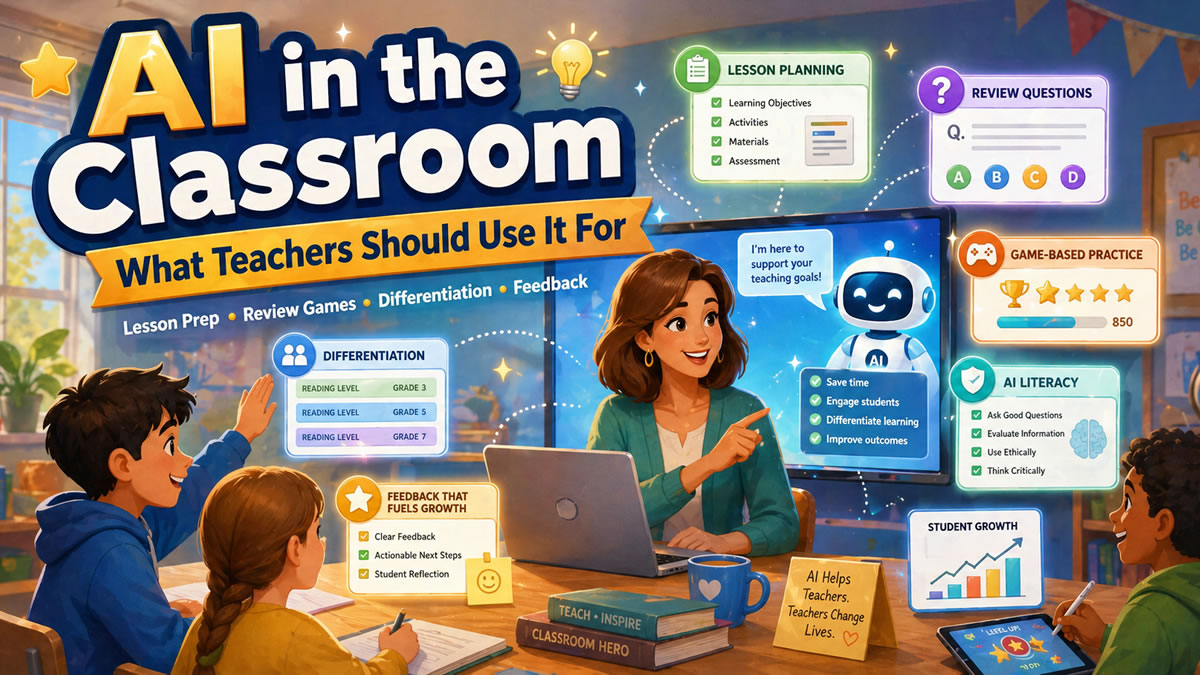
Start with one checked example and build from students' explanations. For broader planning ideas, read AI in the classroom: what teachers should use it for. When you are ready for a review round, create a BrainFusion account and turn your source packet into a small set of reviewed questions.