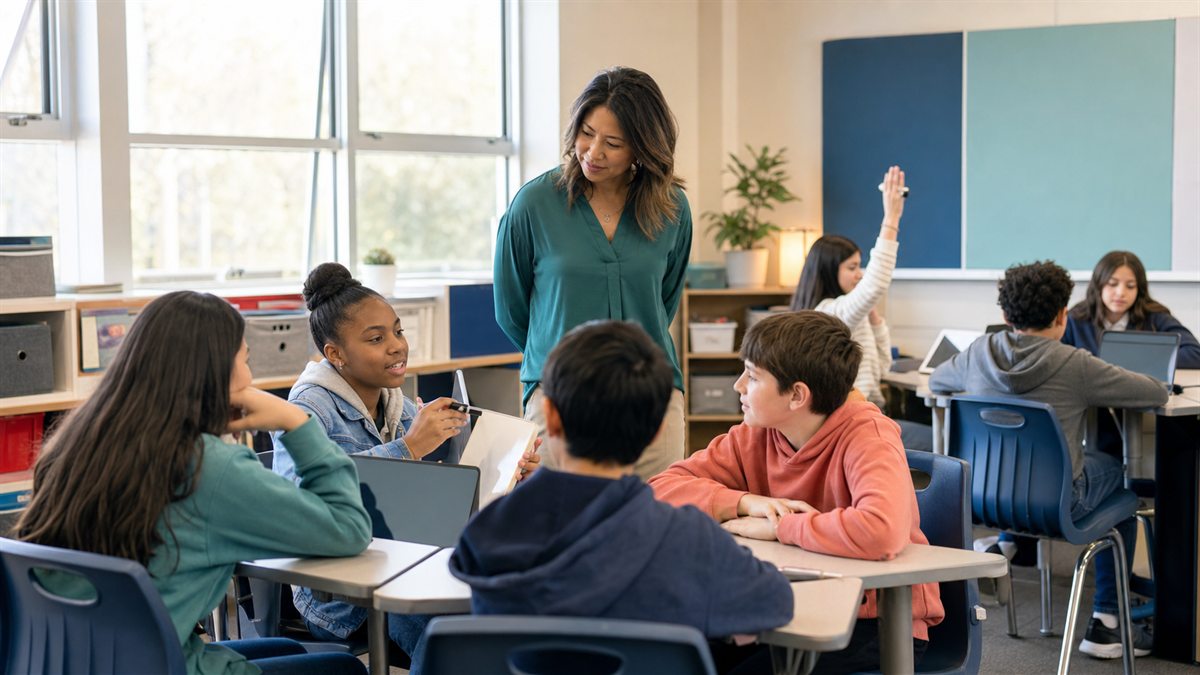
Classroom games do not need to be silent to be well managed. They need a clear learning purpose, a predictable launch, visible participation expectations, and a stopping point that leaves time to discuss what students learned.
The problem is rarely that students are having too much fun. More often, the routine around the game is incomplete. Students do not know when to open devices, how loud discussion should be, what to do after answering, or how quickly they need to stop.
Quick Answer
Use the same four phases every time: Prepare, Launch, Facilitate, and Debrief. Teach the routine before the first full game, assign every student a way to participate, circulate while students play, and stop early enough to turn the results into a learning conversation.
This guide gives you a repeatable classroom game management routine, a copy-ready launch script, a calm reset protocol, and a 20-minute lesson structure you can use with digital or offline games.
Why Classroom Games Can Feel Hard to Manage
Games change several classroom conditions at once. Students may talk more, respond faster, move between groups, watch a score, handle devices, and react publicly to mistakes. None of those conditions is automatically a problem, but together they create more decisions than a worksheet or teacher-led discussion.
That is why “be responsible” is not a complete direction. Students need to know what responsible participation looks and sounds like during this particular activity.
The Australian Education Research Organisation explains that rules and routines support students in being ready to learn. Its guidance defines routines as recurring sequences that teachers model and students practise until they become more automatic.
The CDC similarly recommends clear, consistent expectations for classroom behavior, including written and spoken procedures for completing work and participating in groups.
For classroom games, that means planning the learning routine with the same care as the questions.
Use a Four-Phase Classroom Game Routine
Keep the structure consistent even when the game changes.
| Phase | Teacher’s Main Job | Student Question It Answers |
|---|---|---|
| Prepare | Design the purpose, participation, transitions, and fallback | What are we doing and why? |
| Launch | Explain, model, and rehearse the routine | How do I participate successfully? |
| Facilitate | Circulate, notice, prompt, and protect the learning goal | What should I do while the game is running? |
| Debrief | Stop, interpret results, and choose the next step | What did we learn from this? |
The phases are simple on purpose. A routine is most useful when you can repeat it without creating a new management system for every game.
Phase 1: Prepare for the Predictable Problems
Start by deciding what you want to learn from the activity. “Students will play a review game” is an activity description. A useful purpose is more specific:
- Identify which fraction operations need review
- Check whether students can distinguish claim from evidence
- Practise 12 vocabulary terms from the current unit
- Find the two most common misconceptions before tomorrow’s lesson
The purpose determines the number of questions, grouping, pace, and debrief.
Plan the start and stop before the middle
Most lost time happens at the edges of an activity. Decide these details before class:
- Where devices, cards, or whiteboards will be when students enter
- What students should do while the game loads
- Which signal starts play
- Which signal means freeze, listen, or close the device
- Where unfinished materials go
- What students do if they finish early
- How many minutes you will reserve for the debrief
A visible timer can help, but the routine should not depend on students noticing the final ten seconds. Give a two-minute warning, then use the same stop signal every time.
Give every student a participation path
In a digital game where each student answers, participation may already be individual. In a team game, assign roles so one fast or confident student does not make every decision.
Useful roles include:
- Reader: Reads the prompt aloud when needed
- Thinker: Explains the group’s reasoning
- Checker: Looks for evidence or verifies a calculation
- Reporter: Shares the final answer or question
- Materials lead: Handles cards, markers, or devices
Rotate roles between rounds. Keep the roles academic rather than decorative. Everyone should have a reason to pay attention to the question.
The CDC’s guidance on peer connection and support recommends explicit expectations for respectful listening and structured opportunities for students to help one another understand a problem.
Build an access plan and a fallback
Before class, consider what could prevent a student from participating:
- Reading load or unfamiliar vocabulary
- Small text or low color contrast
- Sound effects or a noisy room
- Fine-motor demands
- Public scoring anxiety
- Limited device access or unreliable internet
- A student joining late or returning after an absence
Adjust the format without changing the learning target. You might read questions aloud, provide a partner role, reduce visual clutter, allow a quiet location, or use printed question cards if technology fails.
Phase 2: Launch the Game in 90 Seconds
A strong launch is brief because students cannot remember ten new directions while waiting to play. Explain only what they need for the first round, then add details after they have a working model.
Use this script:
Today’s goal is to find which [skill or concept] we understand and which part needs another example.

When I say “start,” [open the link / turn over the first card / begin the first round].

During the game, use a [voice-level description] voice. Everyone must [participation expectation].

If you finish a question early, [specific next action].

When you hear or see [stop signal], stop input, look up, and listen. We will practise that once before the full game.

Scores are information about this round, not grades and not labels. Our job is to notice what we know and improve the next answer.
Then run one practice question. Rehearse the stop signal while the stakes are low. If the transition is unclear, teach it again before adding speed, sound, or competition.
The 2024 What Works Clearinghouse guide on teacher-delivered behavioral interventions recommends co-establishing, modeling, and teaching clear expectations, then reminding students and acknowledging expected behavior. That guide is specifically for grades K–5, but the launch sequence provides a useful planning model that secondary teachers can adapt to their own students and school expectations.
Phase 3: Facilitate Instead of Watching From the Front
Once play begins, the teacher’s job changes from explaining to observing. Do not anchor yourself to the display, scoreboard, or teacher computer unless the game requires it.
Circulate with three questions in mind:
- Who is participating?
- Which content is causing confusion?
- Which part of the routine is beginning to slip?
The IRIS Center recommends arranging the room so teachers can move, scan, interact, and maintain clear lines of sight during independent and small-group work. Circulation also lets you give quiet prompts before a minor issue becomes a whole-class interruption.
Use short reminders before long corrections
If students begin to drift, use a brief reminder tied to the taught routine:
- “One voice per group.”
- “Explain before you select.”
- “Checkers, ask for evidence.”
- “Two minutes, then devices down.”
- “The goal is accuracy before speed.”
Name the expected action instead of narrating everything that is going wrong. When students follow the routine, acknowledge the specific behavior: “This table disagreed, checked the source, and then chose an answer.”
Keep competition below the learning goal
Competition can add energy, but it should not determine who gets to think. Avoid eliminating students from academic participation. Do not let the fastest answer end discussion for everyone else.
Before the game, decide how much attention the score deserves. During the debrief, spend more time on reasoning, misconceptions, and improvement than on the winner.
If a public leaderboard changes the tone in an unhelpful way, shift the class goal. Ask students to beat their previous accuracy, explain one difficult answer, or reduce repeated errors across rounds.
Use a calm reset instead of abandoning the game
When the routine breaks down, use this five-step reset:
- Stop: Use the practised signal and wait.
- Name: Describe the observable problem without labeling the class. “Three groups continued after the stop signal.”
- Restate: Give the expected action in one sentence.
- Rehearse: Practise the transition or response once.
- Resume: Restart with a shorter round and immediate feedback.
A reset should make the next attempt clearer. It is not a speech, public shaming, or threat to remove every future game.
If the activity repeatedly fails after a clear reset, stop and switch to the prepared fallback. Protecting the learning goal matters more than finishing a game.
Phase 4: Stop While There Is Still Time to Debrief
The final score is not the debrief. End gameplay three to five minutes before the period or activity block ends.
Ask three questions:
- Which question or concept was easiest to answer, and why?
- Which wrong answer looked reasonable at first?
- What should we review, practise, or explain next?
Students can answer aloud, with a partner, on a sticky note, or in a brief exit response. The format matters less than moving attention from the game result to the learning evidence.
Edutopia’s practitioner guidance on managing in-class gameplay also recommends applying regular classroom norms during games, assigning roles, facilitating actively, and reserving time for reflection rather than playing until the bell.
Use the responses to choose one small next step. That might be a worked example, a small group, a revised question, or a short retrieval round tomorrow. Our guide to question-level analytics and reteaching provides a more detailed decision process.
Plan for Common Game-Day Problems
| Problem | Prevent It | Respond in the Moment |
|---|---|---|
| Students miss the directions | Display only the first three steps and model one round | Pause and ask a student to restate the next action |
| One student dominates | Assign and rotate academic roles | Require the reporter to summarize another student’s reasoning |
| Noise keeps rising | Define a usable voice level and teach a stop signal | Reset the signal, shorten the next round, and acknowledge groups that respond |
| Students rush and guess | Require an explanation, calculation, or evidence check | Pause the score and discuss one tempting wrong answer |
| A score dispute takes over | Explain scoring and tie procedures before starting | Record the question, make a consistent ruling, and move on |
| Technology fails | Prepare printed questions or a board-based version | Shift to the fallback without turning troubleshooting into the lesson |
| Students finish at different times | Post a specific “when finished” task | Direct early finishers to explain, revise, or create a parallel example |
| The game reveals widespread confusion | Plan a checkpoint after a few questions | Stop, model one example, then decide whether to resume |
The goal is not to predict every possible behavior. It is to remove the most common moments of uncertainty.
A 20-Minute Classroom Game Plan
Use this structure for a short review or formative check:
| Time | Activity | Management Focus |
|---|---|---|
| 0:00–2:00 | State the learning goal and launch directions | Purpose, voice level, participation, stop signal |
| 2:00–4:00 | Run one practice question | Model the routine and correct confusion |
| 4:00–13:00 | Play the main round | Circulate, prompt, and watch response patterns |
| 13:00–15:00 | Pause for one misconception | Slow down guessing and clarify reasoning |
| 15:00–17:00 | Run a final short round | Apply the clarification |
| 17:00–20:00 | Debrief and record the next step | Turn results into instruction |
For an opening routine instead of a full activity, adapt our game-based bell ringer ideas. For longer review periods, use the structure in How to Turn Review Days Into Something Students Look Forward To.
Use the Same Routine With BrainFusion
BrainFusion can fit inside the same four phases. The technology changes the delivery, not the classroom expectations.
- Prepare: Build or import a focused question set and review every answer before class.
- Launch: Share the session code and participation expectations. Students can join in a browser without creating accounts or installing an app.
- Facilitate: Circulate while students play one of six learning game types. Watch participation and listen for reasoning instead of watching only the leaderboard.
- Debrief: Review question-level results, discuss a useful misconception, and decide what needs another example or a later retrieval round.
If you need better source questions first, start with the classroom question bank guide. A focused, reviewed question set makes both gameplay and the debrief easier to manage.
Know When a Game Is Not the Right Choice
A game is a tool, not an obligation. Choose another format when:
- Students need direct instruction before they can practise independently
- A conflict or emotionally charged event needs calm discussion first
- The activity cannot be made accessible to a student who needs to participate
- Public speed or scoring would interfere with the learning goal
- Technology problems would consume more time than the practice is worth
- You need valid evidence for a high-stakes assessment
You can also remove one game element without abandoning active learning. Keep the questions but remove the timer. Keep team discussion but remove the public score. Use the same retrieval prompts on whiteboards or paper.
Your Pre-Game Checklist
Before students begin, confirm that you can answer yes to these questions:
- Is the learning goal specific?
- Does every student have a participation path?
- Are the start, stop, and finish actions clear?
- Have students seen or practised the routine?
- Is the expected voice level defined?
- Can I circulate and see each group?
- Is there a task for early finishers?
- Is there an accessible alternative or technology fallback?
- Have I reserved at least three minutes to debrief?
- Do I know what decision the results will help me make?
The best-managed classroom game is not necessarily the quietest or the fastest. It is the one where students know how to participate, the teacher can see what they understand, and the class can stop with a clearer next step.
Sources
- Australian Education Research Organisation: Rules and Routines
- What Works Clearinghouse: Teacher-Delivered Behavioral Interventions in Grades K–5
- CDC: Behavior Management
- CDC: Peer Connection and Support
- IRIS Center: Effective Room Arrangement
- Edutopia: Managing In-Class Gameplay
Run a Focused Learning Game
Create a question set, share a browser-based game, and use the results to plan what students need next.