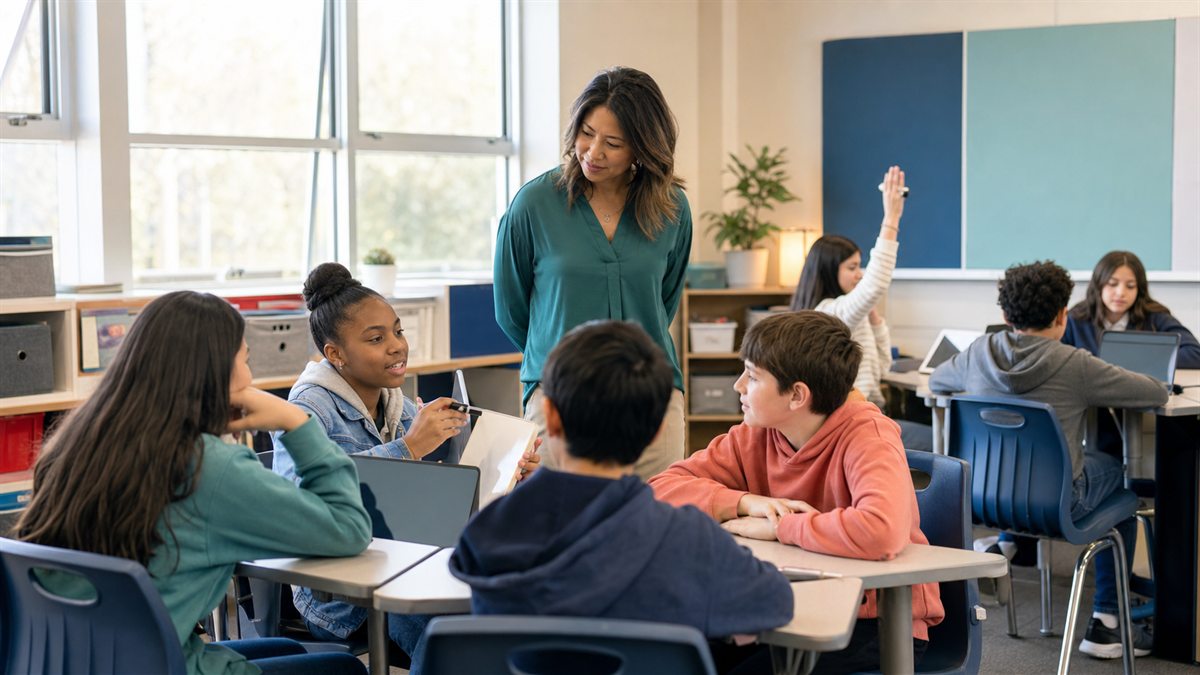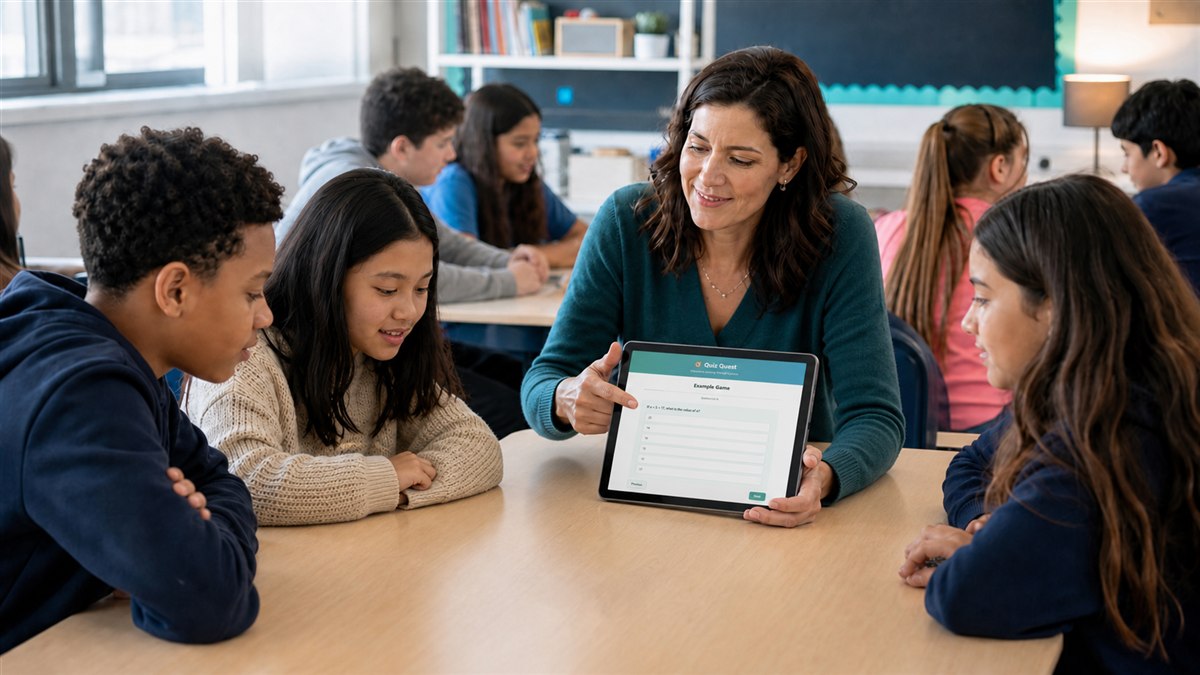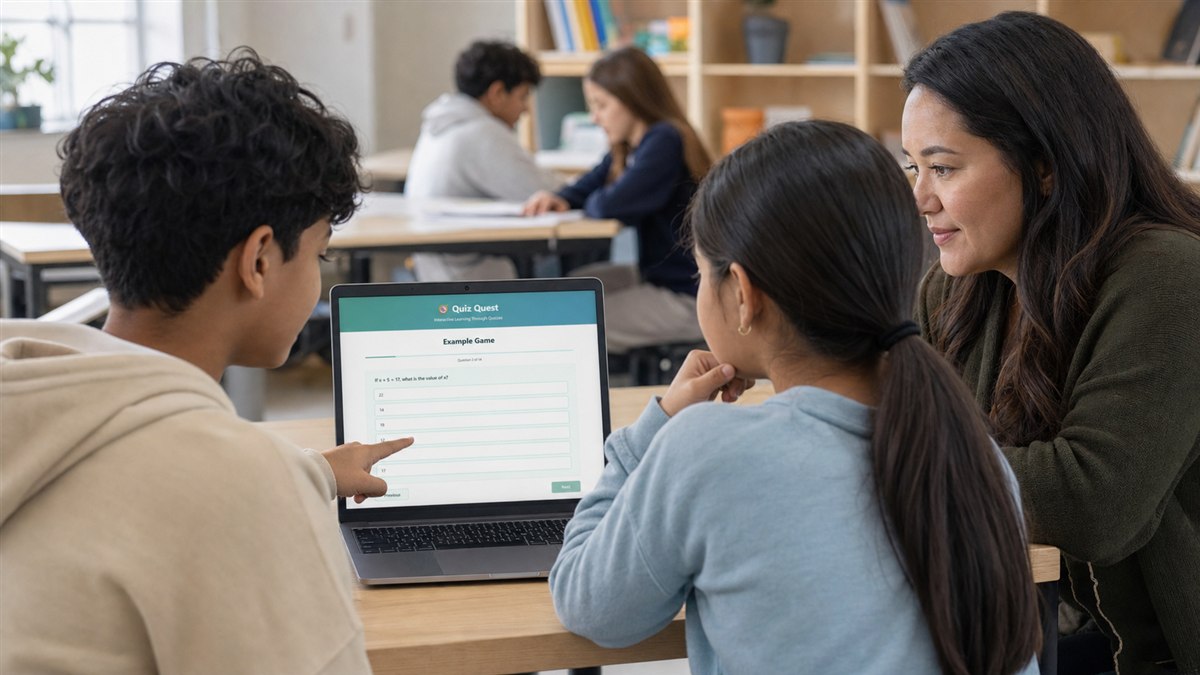
Classroom games can help quiet students participate when the game does not make public speaking the price of entry.
The practical goal is not to make every student louder. It is to give every student a meaningful way to think, answer, rehearse, and contribute. Start with a private response, add partner talk, and make whole-class sharing a supported next step instead of a surprise performance.
Quick Answer
Use a participation ladder: private think time, an individual response, partner rehearsal, a small-group decision, and optional public explanation. Keep the questions challenging, but reduce unnecessary pressure from speed, surprise cold calls, visible rankings, and one required response format.
That approach is useful for students who are naturally reserved, still building confidence, processing in another language, unsure of the content, or simply more comfortable contributing after preparation. A student's volume does not tell you which of those explanations applies, so design the activity before trying to diagnose the student.
Quiet Is Not the Same as Disengaged
A student can be quiet and still be reading closely, solving the problem, noticing patterns, or deciding between two plausible answers. Another student can sound confident without understanding the concept.
That is why participation should produce evidence of thinking, not merely noise.
A timely Edutopia article on supporting quiet students, published August 12, 2026, encourages teachers to recognize students' existing strengths, provide questions in advance, allow flexibility, and use adequate wait time. Those ideas become especially important in a game, where timers, public scores, fast transitions, and excited classmates can add pressure that the learning goal does not require.
The CAST Universal Design for Learning Guidelines 3.0 offer a useful design standard. They recommend varying and honoring methods for response, optimizing choice and autonomy, and building fluency through graduated support for practice and performance. In other words, students can work toward the same learning goal without every response looking or sounding identical.
Build a Participation Ladder
A participation ladder turns one high-pressure moment into several manageable steps:
- Think privately. Every student considers the question before anyone answers.
- Commit to a response. Students choose, write, draw, sort, or enter an answer.
- Rehearse with one person. Partners compare reasoning and revise if needed.
- Contribute to a group. Each student supplies an answer, clue, check, or piece of evidence.
- Share with the class. A student, partner, or designated reporter explains the group's thinking.
Not every question needs all five steps. A quick vocabulary check may stop after the individual response. A misconception worth discussing may move through the full ladder.
The important part is sequence. Asking students to think and rehearse before sharing makes participation more predictable. A 2021 peer-reviewed study, Think and Pair Before Share, found that exchanging ideas with a partner increased hand raising and that validating notes with a partner reduced students' state anxiety. Shy students participated less often overall, but they also benefited from the collaborative step.
Seven Low-Pressure Game Structures
These structures work with paper, whiteboards, slides, or digital learning games. Use the response mode that fits the objective and your students.
1. Think, Choose, Then Explain
Ask a multiple-choice question and give everyone silent time to choose before discussion begins.
After students commit to an answer, say:
Compare with a partner. If your answers differ, explain the clue that led you to your choice. You may change your answer, but be ready to name the evidence.
The first task is private and concrete. The explanation comes after students have something to say and one person with whom to test it.
Use this for:
- Selecting the best evidence for a reading inference
- Predicting the result of a science demonstration
- Choosing the operation needed for a word problem
- Identifying the sentence that uses a vocabulary word correctly
2. Partner Prediction
Show a question, image, equation, map, or short scenario. Partners make a prediction together, then the class reveals the answer through a game or demonstration.
Give each partner a defined move:
- Partner A states the prediction.
- Partner B names one reason or piece of evidence.
- Both agree on the submitted response.
On the next question, switch roles. This keeps one confident student from doing all the talking while giving both students a prepared contribution.
3. Team Consensus Without a Spokesperson Surprise
Small groups answer a question only after every member has shown a choice. Students can point to an option, place a token, write a letter, or select an answer on a device.
If the group disagrees, members compare reasons before submitting. Tell the class in advance how sharing will work. For example:
I will ask two groups to share. Your group may choose its reporter after you finish discussing.
That is different from calling on a quiet student without warning. The group knows public sharing is possible, has time to prepare, and controls who reports.
4. Error Detective
Instead of asking, "Who knows the answer?" give students a completed answer that contains a mistake.
Students work privately first:
- Mark the first step that went wrong.
- Choose a correction.
- Compare with a partner.
- Submit the corrected answer.
This structure moves attention away from the student and toward the work. It also gives the discussion a precise starting point.
For more ways to design useful wrong answers, see how to build better multiple-choice questions with AI.
5. Evidence Match
Give students an answer and several possible reasons. Their task is to match the best evidence to the answer.
For example:
- ELA: Match a claim to the strongest quotation.
- Science: Match an observation to the process it supports.
- Social studies: Match a source excerpt to the historical claim it can support.
- Math: Match a solution to the property or rule used.
A student who is not ready to give a long oral explanation can still demonstrate reasoning by making and defending a match.
6. Role-Rotation Challenge
Give each student a contribution that is larger than "sit with the team" but smaller than "perform for the class."
Useful roles include:
| Role | Contribution |
|---|---|
| Chooser | Selects the team's initial answer |
| Evidence finder | Locates the clue, step, or source that supports it |
| Checker | Tests the answer against the directions or example |
| Questioner | Asks one clarifying question before submission |
| Reporter | Shares the final reasoning when the group is called |
Rotate the roles after one or two rounds. Do not permanently assign the quiet student to a silent job. The point is graduated practice, not a fixed identity.
7. Quiet Debrief
End the game with a response every student can complete privately:
- Which answer did you change, and why?
- Which question needs another example?
- What clue helped you most?
- Which mistake would be easiest to make again?
- What should we review tomorrow?
Students can submit the reflection on paper, in a form, or through a short follow-up question. The teacher gets evidence from students who may not speak during the whole-class debrief.
Run a Participation Pressure Audit
Before starting a game, separate productive challenge from avoidable performance pressure.
| Check | Higher-Pressure Version | Lower-Pressure Adjustment |
|---|---|---|
| Thinking time | First hand wins | Everyone gets silent think time |
| Response mode | Speak to the class | Choose, write, point, or enter an answer first |
| Partner work | Find a partner immediately | Teacher assigns predictable pairs or groups |
| Public sharing | Surprise cold call | Advance notice, volunteer, or chosen group reporter |
| Scoring | Speed and rank dominate | Accuracy, reasoning, revision, or team progress matter |
| Mistakes | Wrong answer attached to a student | Discuss the answer pattern without naming the student |
| Debrief | Same voices answer again | Private reflection followed by optional sharing |
The goal is not to remove every challenge. Oral communication may be the learning goal in a language, debate, presentation, or seminar lesson. In that case, keep the speaking requirement and reduce unrelated pressure: preview the prompt, provide rehearsal, define a short response length, and build from partner to group to class.
A 20-Minute Routine That Includes Every Student
This routine works for a five- to eight-question review game.
| Time | Activity | Teacher Move |
|---|---|---|
| 0–2 minutes | Preview | Explain the learning goal, participation ladder, and option to pass during public sharing |
| 2–5 minutes | Private round | Students answer two questions independently with generous think time |
| 5–10 minutes | Pair round | Partners compare answers and submit a shared reason or correction |
| 10–16 minutes | Game round | Students answer three or four content questions; pause once for team consensus |
| 16–19 minutes | Quiet debrief | Every student completes one reflection or misconception check |
| 19–20 minutes | Next step | Teacher names what the class will review, practice, or move past |
The IES Regional Educational Laboratory reading-comprehension toolkit recommends giving students time to prepare for discussion and modeling wait time after questions so everyone can think before someone responds. Although that toolkit focuses on K–3 reading, the planning principle transfers well: preparation belongs inside the activity, not only before it.
IES also reports student-centered guidance from the ENACT teacher partnership, including pair work, quiet ways to contribute, and opportunities to lead. A well-designed game can offer all three in one routine.
How to Adapt a Digital Classroom Game
Digital response tools can give every student an immediate way to commit to an answer, but the device alone does not make participation inclusive. The surrounding routine still matters.
For a lower-pressure digital game:
- Preview the first question so students understand the format.
- Use five to eight focused questions instead of a long competitive session.
- Give enough answer time for reading, thinking, and checking.
- Let students rehearse reasoning with a partner before selected questions.
- Avoid projecting the live leaderboard when rank would distract from the learning goal.
- Discuss class-level answer patterns without identifying who missed a question.
- Follow the game with one private reflection or recheck.
With BrainFusion, students join in a browser with a short session code and a display name; they do not need an account or installation. Teachers can build or import a focused question set, reuse it across six playable learning game types, adjust answer timing, and review question-level results after the session.
Those results are a starting point for a conversation, not a label. A missed question may reflect incomplete knowledge, confusing wording, rushed reading, or an unhelpful distractor. Check the item and ask for another form of evidence before deciding what a student needs.
For a fuller follow-up process, use question-level analytics to plan reteaching.
What Not to Do
- Do not equate quiet with low ability. Use actual work and responses as evidence.
- Do not make speaking a punishment. Losing a round should not trigger an unplanned solo performance.
- Do not announce that the game is "for the shy students." Use the structure with everyone.
- Do not let the fastest voices answer every question. Require private thinking before discussion.
- Do not remove all speaking forever. When speaking serves the learning goal, build toward it with rehearsal and support.
- Do not ignore individual plans. Follow required accommodations and work with the student's support team when participation concerns are persistent or significant.
- Do not treat a leaderboard as mandatory. A game can retain challenge, feedback, and purposeful practice without projecting rank.
Your Pre-Game Checklist
Before using a classroom game with quiet students, confirm:
- Every student has private think time.
- The first response does not require public speaking.
- Students know whether and how whole-class sharing will happen.
- Partners or groups are assigned in a predictable way.
- Roles give each student a real contribution.
- Speed is not being used as a substitute for understanding.
- Students may revise an answer after discussion.
- Public feedback focuses on ideas and answer patterns, not embarrassment.
- The debrief includes a quiet response path.
- The game produces evidence that will change what happens next.
Classroom participation does not have to begin with a raised hand. It can begin with a thoughtful pause, a selected answer, a note in the margin, or one sentence shared with a partner.
Design the game so those first steps count. Then give students a supported path toward the next one.
Sources
- Edutopia: 5 Ways to Connect With the Quiet Students in Your Classroom
- CAST: Universal Design for Learning Guidelines 3.0
- Institute of Education Sciences: ENACT Teachers Learn New Ways of Aligning Instructional Strategies to Students' Needs
- Institute of Education Sciences: Toolkit for Teaching K–3 Reading Comprehension
- Learning and Individual Differences: Think and Pair Before Share
Create a Lower-Pressure Classroom Game
Build a focused question set, give students time to think, and turn every response into useful practice.