Game-based learning can make corporate training more active by asking employees to recall information, choose an action, and receive feedback. Its most useful role is often a short practice activity after instruction, not a replacement for the instruction itself.
For HR and L&D teams, the decision starts with a specific question: what should employees be able to do differently after this training? A game is worth trying when its questions help people practice that decision and its results help a trainer choose the next step.
This guide explains where games fit, where another approach is needed, and how to run a small pilot without treating participation as proof of performance.
Start With the Training Need, Not the Game
Suppose support employees keep sending requests to the wrong team. Before creating a routing quiz, check the cause. Do people misunderstand the routing rules, or is the current directory hard to find? Are the rules contradictory? Do employees lack permission to use the correct queue?
A knowledge game can help someone practice a clear rule. It cannot repair a broken directory or resolve conflicting instructions.
CDC's Quality Training Standards begin with needs assessment and explicitly note that training is not always the solution. For a workplace pilot, first identify whether the gap is knowledge, practice, access, or process design.
Write the objective as an observable action:
Given a customer request and its account type, the employee can select the appropriate support queue and identify when escalation is needed.
That gives the trainer something more useful to assess than whether employees enjoyed a competition.
Where Game-Based Corporate Training Fits
Onboarding: Practice a Small Set of First-Week Decisions
New hires can rehearse where to find help, which team owns a request, or how to interpret a common customer question. Provide the instruction and resources first, then use a short activity to reveal what needs clarification.
Choose a few decisions rather than testing the entire handbook. Our gamified onboarding activities include options for buddy-led practice, team norms, and later refreshers.
Policy Updates: Check What Changed
Focus the activity on the changed rule and the situations where it matters. A useful question might ask which approval is needed under the current policy, with an explanation grounded in the approved source.
Keep required acknowledgments and completion records in the designated system. Answering a practice question is not equivalent to signing a policy acknowledgment.
Product Knowledge: Connect a Request to a Relevant Response
Sales and support teams can practice distinguishing similar features, identifying a limitation, or recognizing a request that needs specialist help.
Use the current product documentation as the answer source. For examples beyond feature recall, see product knowledge training games for sales and support teams.
Recurring Review: Return to Decisions That Were Difficult
A first session can expose an unclear question or a missed concept. A later activity can revisit the same objective using a different example.
The trainer still needs to plan the follow-up. A collection of unrelated games is not automatically a reinforcement program.
Know When a Game Is Not Enough
A quiz about a customer conversation does not demonstrate that an employee can handle that conversation. Equipment operation requires appropriate instruction and observed practice. Sensitive conduct topics may need private discussion, specialist facilitation, and established reporting channels.
Use games to rehearse or check knowledge where appropriate. Use observation, coaching, simulations, or formal assessment when the objective requires demonstrated performance.
Also consider the conditions of participation. A fast leaderboard may not suit every learner or topic. Offer an accessible, lower-pressure way to practice, and avoid making a public score an employment judgment.
Plan a Small Corporate Training Pilot
Here is an illustrative pilot for a fictional support team. It is a planning example, not a customer case study or a claim about achieved results.
- Choose one decision. Employees need to distinguish a routine account request from one requiring supervisor review.
- Confirm the source. The process owner checks the current routing instructions and resolves ambiguous cases before training.
- Teach the process. Explain the rule, demonstrate the directory, and let employees ask questions.
- Run a short practice round. Use a few realistic requests with one defensible answer each.
- Discuss the reasoning. Explain why a tempting wrong route does not fit. Check whether the question omitted needed information.
- Follow up in the workflow. Ask the supervisor to review an appropriate sample of later routing decisions through the team's normal quality process.
Set the session length around the task and participants. Five to ten minutes may be a convenient starting point for a small question set, but it is not a guaranteed learning threshold.
To build the questions, use our employee training knowledge-check template.
Measure Participation, Learning, and Application Separately
Decide what each measure can tell you before the pilot:
- Participation: Did people get access and take part? Investigate scheduling or device problems when they did not.
- Knowledge: Which questions were answered correctly, and which alternatives caused confusion? Check question quality before drawing conclusions.
- Later recall: Can employees answer a comparable question after a delay, without simply recognizing the original wording?
- Workplace application: Are employees using the process correctly in real work? Collect this evidence through an appropriate operational review.
CDC's training evaluation guidance distinguishes learning from learning transfer and recommends follow-up evaluation. A game score alone cannot establish improved job performance.
If the pilot looks promising, expand gradually. Keep changes to staffing, instructions, and workload in mind when interpreting results. For a practical follow-up approach, read how to improve knowledge retention after employee training.
Where BrainFusion Fits
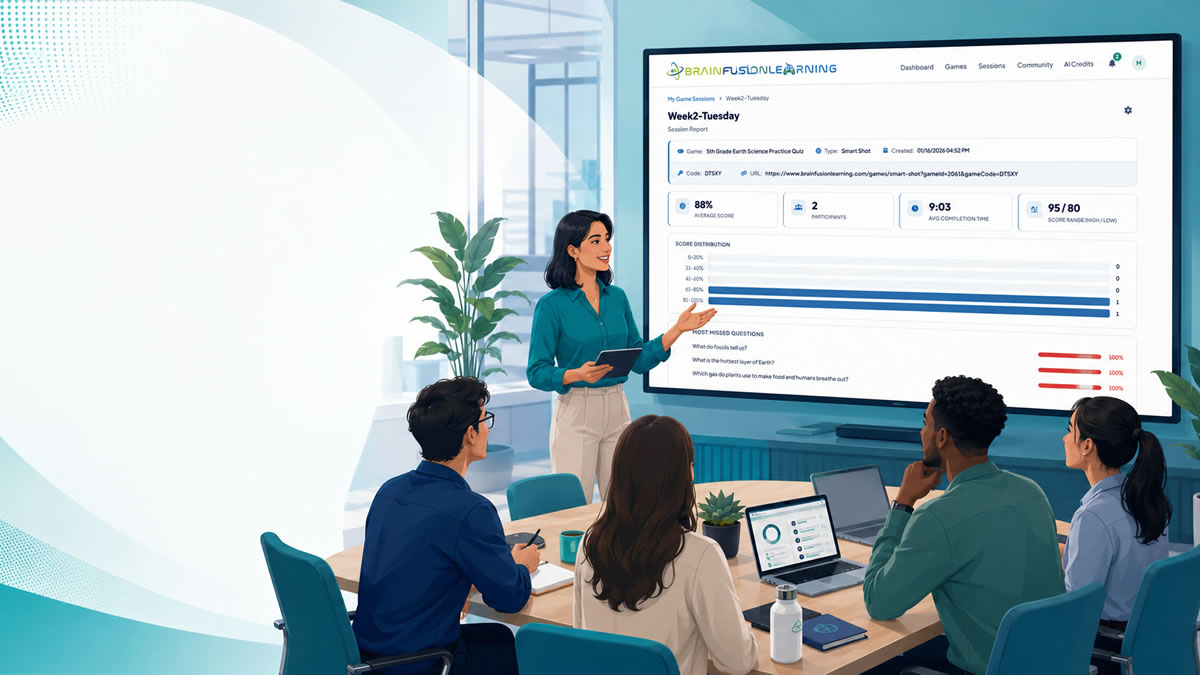
BrainFusion helps trainers create browser-based learning games from their own questions or AI-assisted drafts. Employees can join through a game code without creating an account, and trainers can review session summaries and question-level results.
That makes it an option for low-friction practice. It does not provide verified employee identity, required compliance certification, or proof of job competence through the standard join-code workflow. Keep those responsibilities in the systems and processes designed for them.
Start with one approved topic, review the questions, and decide what follow-up the results will inform. The corporate-training overview explains the product's role, and organization pricing is the next step for discussing a team rollout.
Try One Focused Training Activity
Create a short practice game from an approved process, then use the results to plan a useful follow-up.