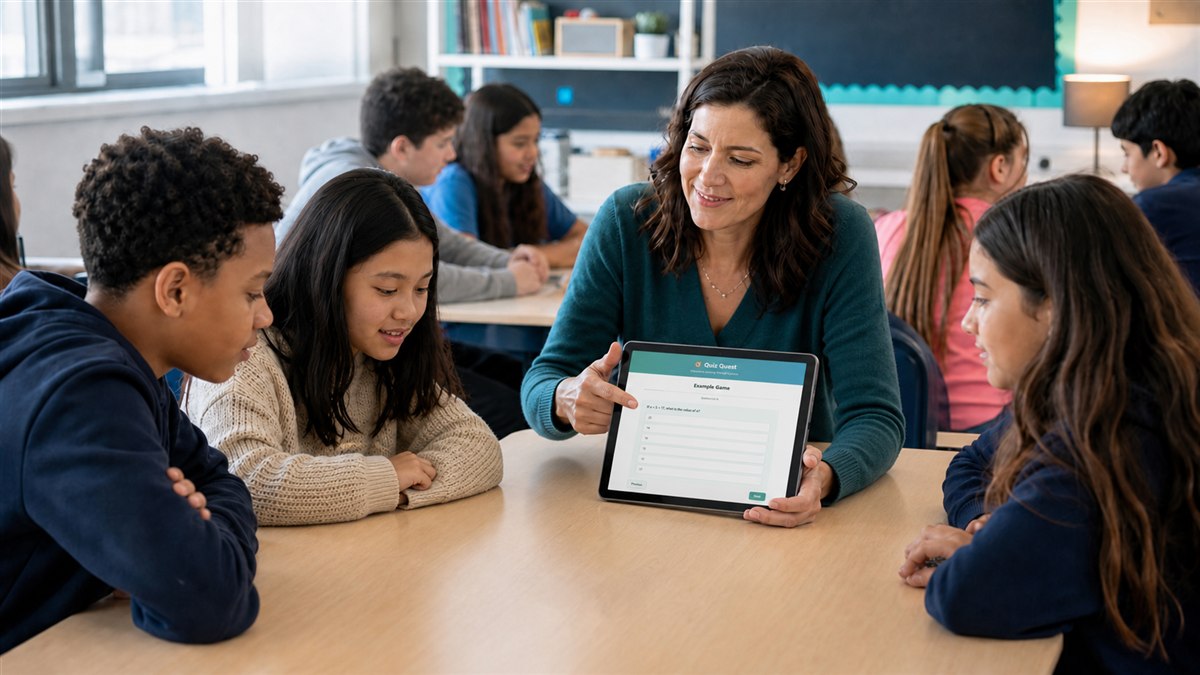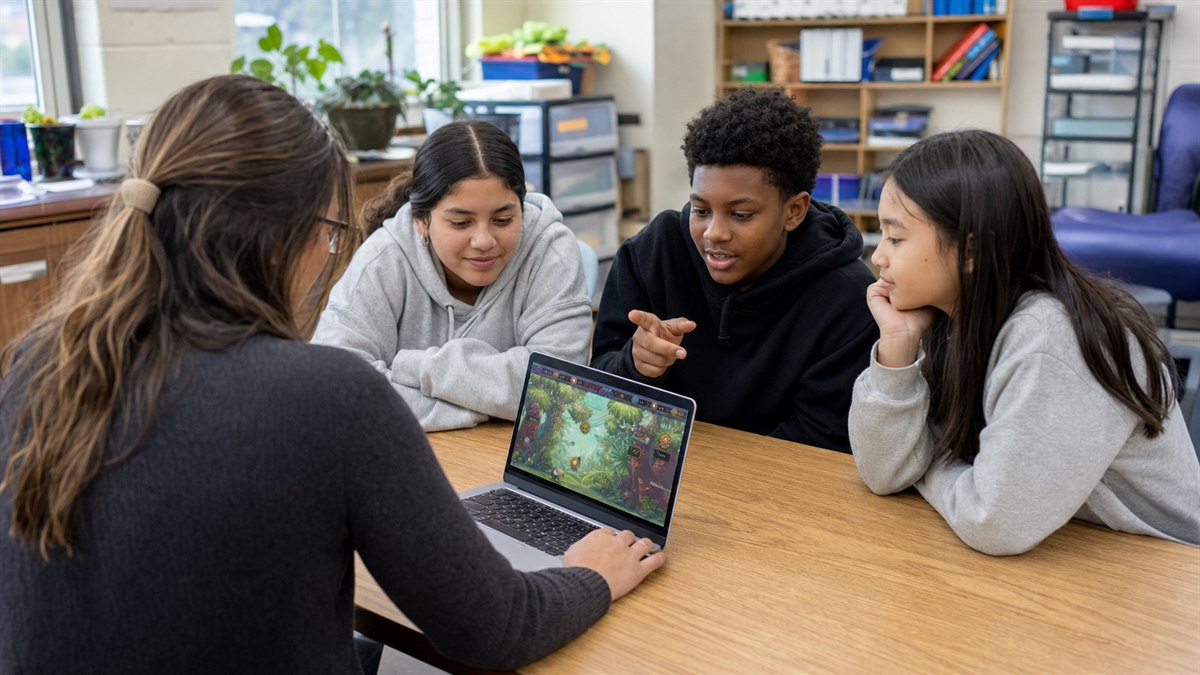
Classroom games for mixed-ability students work best when everyone pursues the same learning goal but can receive different support, challenge, or ways to respond.
You do not need three separate games for three supposed ability levels. Start with one shared question set, adjust the route into the task, and use student responses to decide who needs a scaffold, a deeper challenge, a partner, or another example.
Quick Answer
Keep one clear learning goal for the class. Differentiate the game with four levers: access, question demand, grouping, and evidence. Offer temporary supports without lowering the goal, use extension questions that deepen thinking instead of adding more work, change groups according to the current task, and let the first round determine what happens next.
This guide gives you a practical framework, a question ladder, a worked classroom example, a 20-minute routine, and a copy-ready prompt for building a game that includes more than one entry point.
Mixed-Ability Does Not Mean Fixed Ability
“Mixed-ability classroom” is a common search term, but mixed-readiness is usually a more useful way to plan. A student can be ready for an extension in geometry and need vocabulary support in science. A confident speaker may need help organizing a written explanation. Readiness changes by topic, task, language demand, prior knowledge, and even the day.
That is why permanent “high,” “middle,” and “low” game groups can mislead both teachers and students.
The Education Endowment Foundation’s guidance on adaptive teaching distinguishes focused support from creating a multitude of different resources. It emphasizes assessment, temporary scaffolding, and adjustment before and during a lesson.
For games, the practical shift is simple:
- Keep the essential learning target shared.
- Change the support or challenge around that target.
- Treat the first response as evidence, not a label.
- Remove scaffolds when students no longer need them.
- Let students surprise you.
Use One Goal and Four Differentiation Levers
Before choosing a game format, write one sentence that describes what every student should practise or demonstrate.
For example:
Students will explain how a change in one population can affect other organisms in a food web.
That goal is more useful than “review ecosystems” because it tells you which questions belong in the game and what counts as stronger reasoning.
Then adjust four levers around the shared goal.
| Lever | What You Can Adjust | What Should Stay Stable |
|---|---|---|
| Access | Vocabulary support, visuals, reading load, examples, response time | The central concept or skill |
| Question demand | Recognize, explain, apply, justify, revise | Alignment to the learning goal |
| Grouping | Independent, partner, same-need, or mixed-readiness groups | Respectful participation and accountability |
| Evidence | Pause, reteach, regroup, extend, or revisit later | The use of responses to guide a real decision |
The levers can change between rounds. They do not need to become permanent tracks.
Lever 1: Adjust Access Without Replacing the Goal
An access scaffold helps a student enter the same task. It does not complete the thinking for them.
Useful game-day supports include:
- Reading the prompt aloud while students follow the text
- Previewing two or three essential terms
- Pairing a word with a diagram, symbol, or worked example
- Reducing visual clutter around the question
- Offering a sentence starter for an explanation
- Giving private think time before team discussion
- Allowing a student to point, select, speak, or write when the response mode is not the skill being measured
- Keeping a model available for the first round, then removing it
CAST’s Universal Design for Learning Guidelines 3.0 recommend multiple ways to perceive information and respond, graduated support for practice, and a balance of challenge and support. The point is not to make every activity effortless. It is to remove barriers that are unrelated to the learning goal.
Suppose the goal is to compare fractions. A number line may help a student reason about magnitude without making the comparison easier. If the goal is independent number-line construction, however, providing a completed number line would change what the question measures.
Ask this before adding a scaffold:
Does this support help the student show the target skill, or does it perform the target skill for them?
For language-specific scaffolds, use the response ladder and content examples in Classroom Games for English Language Learners. For students who need more rehearsal before public sharing, see our low-pressure participation structures.
Lever 2: Build a Question-Demand Ladder
Differentiation does not have to mean different topics. You can ask increasingly demanding questions about the same concept.
Use this four-rung ladder when building a game:
| Rung | Thinking Move | Ecosystem Example | Use It For |
|---|---|---|---|
| 1. Identify | Recognize a term, feature, or relationship | Which organism is a producer? | Entry check and vocabulary access |
| 2. Explain | Describe why an answer is correct | Why does the rabbit depend on the grass? | Core understanding |
| 3. Apply | Use the idea in a new situation | What is likely to happen if the rabbit population decreases? | Transfer and extension |
| 4. Justify or revise | Evaluate reasoning or improve an answer | A student says only foxes are affected. What did the student overlook? | Deeper challenge and misconception analysis |
Not every student must start at rung one, and no student should be trapped there. Begin with a brief common check, then provide the next useful level of challenge.
Make extensions deeper, not merely longer
Fast finishers do not need five more questions that repeat the same thinking. Give them a different intellectual move:
- Explain why a tempting wrong answer is wrong.
- Compare two valid strategies.
- Apply the idea to an unfamiliar scenario.
- Add a constraint that changes the solution.
- Rewrite a weak question so it tests the goal more accurately.
- Create a new example and defend the answer.
These options preserve the shared topic while increasing reasoning demand.
Lever 3: Group by Today’s Need, Not Yesterday’s Label
Grouping should have a purpose that you can state in one sentence.
Useful options include:
- Independent first response: Everyone commits to an answer before discussion.
- Partner rehearsal: Students compare reasoning before a whole-group reveal.
- Same-need group: Students who missed the same concept receive a short model or another example.
- Mixed-readiness group: Students contribute different representations, strategies, or explanations to a shared problem.
- Temporary extension group: Students who are secure apply the concept while the teacher supports another group.
The EEF’s guidance on flexible grouping recommends grouping according to current learning needs, using formative assessment to choose groups, and avoiding long-term arrangements that imply ability is fixed.
Change the groups when the purpose changes. A student who needs support with the first question may explain the clearest strategy on the third.
Keep group roles academic
In team games, rotate roles that require thinking:
- Reader: States the question and clarifies key information.
- Solver: Proposes a first answer or strategy.
- Checker: Looks for evidence, calculation errors, or missing details.
- Explainer: Summarizes the group’s reasoning.
Do not make one student the permanent tutor or the permanent device operator. Both arrangements can hide what other students understand.
Lever 4: Use the First Round to Choose the Second
A differentiated game is responsive. The first round should help you make a decision, not simply produce a score.
The Australian Education Research Organisation’s 2026 overview of formative assessment describes low-stakes quizzes and probing questions as ways to identify misconceptions, provide timely feedback, and adjust instruction during learning.
Plan one hinge question that separates different kinds of understanding. Each answer choice should tell you something useful.
For a lesson on area and perimeter, the options might represent:
- Correctly calculating both measures
- Confusing area with perimeter
- Using the correct operation with one arithmetic error
- Counting only two sides of the figure
Then connect each pattern to a next move.
| Response Pattern | Next Move |
|---|---|
| Most students choose the same misconception | Pause for a whole-class model, then retry |
| A small group shares one gap | Give that group a focused example while others apply the skill |
| Answers are correct but explanations are weak | Add partner reasoning before the next reveal |
| Most students are secure | Move to an application or justification question |
| Results are scattered | Check whether the directions, vocabulary, or question design caused confusion |
Recent EEF guidance on checking for understanding recommends gathering evidence from all students, anchoring checks to the learning intention, and creating conditions where mistakes are safe. A leaderboard or a few volunteer answers cannot give you the same picture.
A Worked Example: One Food-Web Game, Three Paths
Imagine a seventh-grade science class reviewing food-web relationships.
Shared goal: Explain how a population change can affect multiple organisms in a food web.
Round 1, common check: Every student answers four short questions. The teacher looks for one distinction: can students trace a direct relationship, or are they treating each organism in isolation?
Round 2, temporary paths:
- Students who need access support use a labeled food-web image and sentence frame: “If ___ decreases, then ___ may ___ because ___.”
- Students who show the core relationship explain a two-step effect with a partner.
- Students ready for extension evaluate a claim that overlooks competition between two species.
Round 3, regroup: Students move into mixed-readiness teams. Each person receives a role and the group analyzes one new scenario. The reporter must explain a teammate’s reasoning rather than repeat their own.
Debrief: The class examines one common misconception and answers the hinge question again without the original support.
The topic and goal never changed. The route, support, and demand did.
A 20-Minute Mixed-Readiness Game Routine
| Time | Activity | Differentiation Decision |
|---|---|---|
| 0:00–2:00 | State the shared goal and participation routine | Clarify what everyone is practising |
| 2:00–6:00 | Run three or four common diagnostic questions | Gather evidence from every student |
| 6:00–8:00 | Pause and sort response patterns | Choose support, grouping, and extension |
| 8:00–14:00 | Run the adjusted round | Use temporary paths around the same goal |
| 14:00–17:00 | Regroup for one application question | Check whether understanding transfers |
| 17:00–20:00 | Debrief and record the next step | Decide what to reteach, revisit, or extend |
If transitions or noise are likely to consume the adjustment time, establish the four-phase routine in How to Run Classroom Games Without Losing Control first.
Adapt Common Game Formats
| Game Format | Access Option | Core Task | Meaningful Extension |
|---|---|---|---|
| Whole-class quiz | Read aloud, add a visual, protect think time | Select and explain | Diagnose a distractor |
| Team challenge | Assign roles and provide a model | Agree on evidence | Defend a second valid strategy |
| Matching or sorting | Reduce the first set or add category labels | Sort and explain the rule | Add an exception and justify it |
| Scenario game | Highlight relevant facts | Choose the best response | Revise the scenario when one condition changes |
| Student-written questions | Provide a question stem | Write and answer one aligned item | Improve a distractor or challenge another team’s item |
The support should be easy to add and easy to remove. If maintaining it requires a separate lesson plan, look for a smaller adjustment first.
Use BrainFusion as the Shared Practice Layer
BrainFusion can support this routine without pretending to make the instructional decisions for you.
- Build one focused question set. Include a short common check, several core questions, and two or three application or misconception questions. Review every answer before class.
- Choose the delivery setup. Students can join a game in a browser without creating accounts or installing an app. You can also guide a small group around one teacher-controlled device when that better fits the lesson.
- Keep the learning goal visible. Students can practise through any of six learning game types, but the question quality and participation routine still determine what you learn from the activity.
- Read patterns, not labels. Use question-level results to see where answers cluster, then decide whether to model, regroup, add support, or extend.
- Run a short follow-up. Revisit the difficult concept after feedback so students can use the correction.
BrainFusion provides retrieval practice and immediate feedback during gameplay. It does not automatically know why a student missed a question, assign a permanent level, or replace a teacher’s judgment. Our guide to question-level analytics and reteaching shows how to investigate response patterns before choosing a follow-up.
Copy-Ready AI Prompt for a Layered Question Set
Use this prompt in an AI question generator, then verify every item against your curriculum and source material:
Create a 12-question classroom review game for [grade/course] on [topic].

Shared learning goal: [what every student should understand or do].

Build the set in this order:
- 3 entry questions that check essential vocabulary or prerequisite knowledge
- 5 core questions that require students to explain or apply the learning goal
- 2 hinge questions whose wrong answers each represent a specific misconception
- 2 extension questions that require justification, comparison, revision, or transfer to a new situation

For every question:
- Keep the content aligned to the shared learning goal
- Use clear, age-appropriate language
- Provide one correct answer and plausible distractors
- Identify the thinking demand and the misconception behind each distractor
- Do not rely on trivia, trick wording, or speed

After the questions, suggest one temporary scaffold for the core task and one deeper extension that does not add repetitive work.
If you plan to reuse the set, organize it with the workflow in How to Build a Classroom Question Bank.
Avoid These Differentiation Traps
- Three permanent versions of every game: This creates workload and can turn temporary needs into fixed tracks.
- Easier work with a different goal: A disconnected worksheet may keep a student busy without helping them reach the class target.
- More questions as the only extension: Volume is not the same as depth.
- Speed as a proxy for readiness: Fast responses can reflect confidence, familiarity, reading speed, or guessing.
- Public ability labels: Team names and visible levels can communicate expectations you did not intend.
- The same student always helping: Peer explanation can support learning, but permanent tutoring roles limit both students.
- Scaffolds that never fade: Check whether the support is still necessary after feedback and practice.
- Treating game scores as grades: Use the round as low-stakes evidence unless the activity meets your school’s requirements for valid assessment.
Your One-Game Differentiation Checklist
Before the game, ask:
- Is there one clear learning goal for everyone?
- Do my questions move from access to explanation, application, or justification?
- Are supports tied to a specific barrier rather than an assumed ability level?
- Can each scaffold be removed when it is no longer needed?
- Does the extension deepen thinking instead of adding repetitive work?
- Will every student produce an answer before volunteers or teams take over?
- Does each grouping choice have a current instructional purpose?
- Have I planned one hinge question and a response for each likely pattern?
- Is there time to adjust the second round and debrief?
- Am I using the results to make a decision rather than rank students?
The most useful mixed-ability classroom game is not the one with the most versions. It is the one that keeps the class working toward a shared goal while giving the teacher enough evidence to adjust support and challenge at the right moment.
Sources
- CAST: Universal Design for Learning Guidelines 3.0
- Education Endowment Foundation: Assess, Adjust, Adapt
- Education Endowment Foundation: Flexible Grouping
- Education Endowment Foundation: Checking for Understanding
- Australian Education Research Organisation: Formative Assessment at a Glance
Build One Game With Multiple Ways In
Create a focused question set, run a low-stakes first round, and use question-level results to choose the next support or challenge.