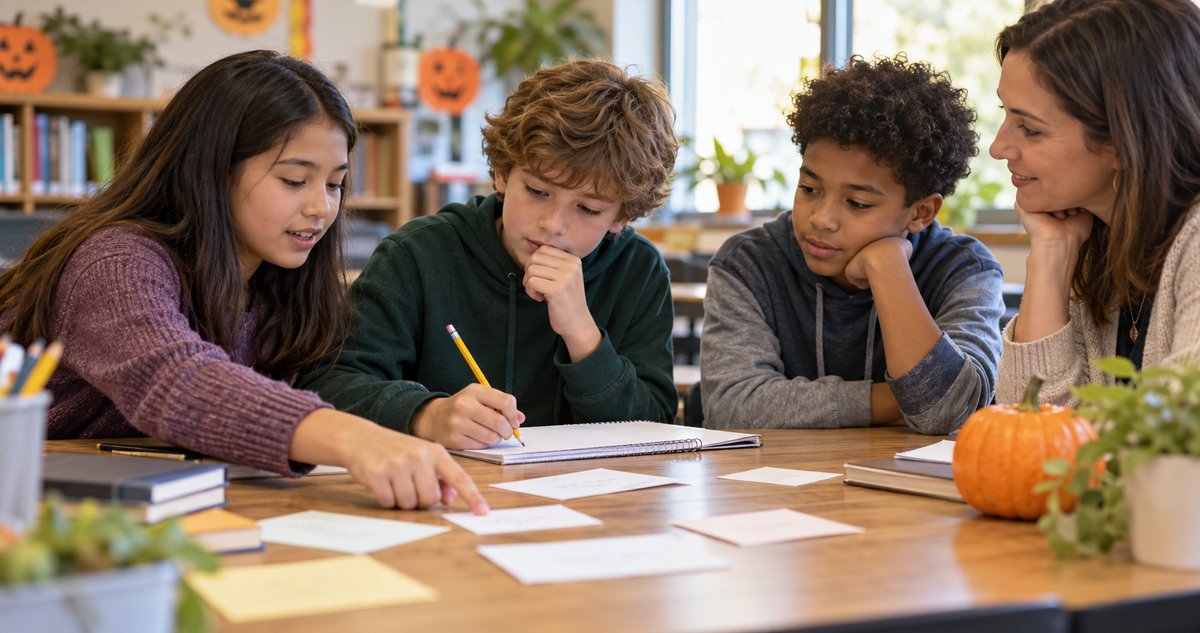
Useful Halloween classroom games start with something students have already learned: a vocabulary distinction, a calculation, or a science explanation. Add a seasonal name, give everyone time to answer, and finish by checking what needs another explanation.
The five activities below work with paper, a projector, or a short digital review. Each includes a worked example and a fall-themed alternative. Choose one for a quick check, or use the 20-minute plan and question set for upper-elementary or middle-school review.
Updated October 26, 2026: This guide replaces our original October 2025 article with new classroom examples, answer explanations, and a practical lesson plan.
Choose a game around your learning goal
Use content students have encountered in lessons. The seasonal setting should be easy to understand without knowing Halloween traditions or celebrating the holiday.
| Activity | Time | What students practice |
|---|---|---|
| Misconception Mystery | 5–8 minutes | Finding and correcting an error |
| Vocabulary Clue Hunt | 5–10 minutes | Connecting a term with evidence |
| Pumpkin Problem Pairs | 8–10 minutes | Solving and explaining a calculation |
| Halloween Review Quest | 10–15 minutes | Answering a focused question set |
| Exit-Ticket Detective | 3–5 minutes | Applying an idea independently |
These are suggested timings, not promises about preparation or completion. Before class, check the examples against your curriculum, separate the questions from the answer key, and decide how students will respond.
There is a learning reason to revisit taught material: the What Works Clearinghouse guide on organizing instruction and study recommends quizzing to re-expose students to key content. That supports the review task. It does not establish that pumpkins, costumes, or a Halloween theme improve memory.
1. Misconception Mystery
You need: One deliberately incorrect statement and somewhere for students to write a correction.
Tell students that the statement contains an error. Give them a minute to think privately, then have pairs identify the error and replace it with an accurate explanation. The challenge is to repair the reasoning, not to catch out a classmate.
Worked example: equivalent fractions
A fictional pumpkin-stall sign says: “One-half equals two-thirds because you add one to both the numerator and denominator.” What should the sign say instead?
Teacher explanation: Adding the same number to the numerator and denominator does not generally preserve a fraction's value. Multiplying both by the same nonzero number does: one-half equals two-fourths. Equal-sized fraction strips can show why one-half and two-thirds cover different amounts of the same whole.
Ask students to explain why their correction works. A student who writes “two-fourths” without an explanation may have recalled an example without understanding the rule. Follow up with “What would happen if we multiplied both numbers by three?”
Fall alternative: Call it “Fix the Farm-Stand Sign.” Keep the mathematics identical.
2. Vocabulary Clue Hunt
You need: A small set of previously taught terms and short clues that distinguish them.
Read one clue at a time. Students choose a term privately, then tell a partner which detail supports their choice. Give credit for an accurate explanation, not for shouting first.
Worked example: changes of state
Term choices: evaporation, condensation, freezing.
Water vapor in the surrounding air cools and becomes liquid droplets on the outside of a cold cup at the classroom pumpkin display. Which term fits?
Answer: Condensation. The water changes from gas to liquid. It has not leaked through the cup, and it has not become solid ice.
For a second clue, describe liquid water becoming solid ice in a freezer. Ask students to explain what changed between the two examples. Listen for whether they understand the direction of the change, rather than simply matching “cold” with a word.
Fall alternative: Use a cold cup at a harvest display, or remove the display entirely. For more formats, see our classroom vocabulary games.
3. Pumpkin Problem Pairs
You need: Two short problems that use the same taught skill, with different numbers or contexts.
Give everyone the first problem to solve independently. Partners compare methods, resolve disagreements, and then attempt the second problem individually. Avoid assigning one student all the calculating and the other all the explaining.
Worked example: equal groups
A class arranges 24 paper pumpkins equally across six display boards. How many go on each board?
Answer: Four. There are six groups, so 24 ÷ 6 = 4. Students can check with 6 × 4 = 24.
Follow with: “Thirty paper leaves are shared equally across five boards. How many go on each?” The answer is six, because 30 ÷ 5 = 6.
If a student multiplies 24 by six, ask them to identify the total and the number of groups before selecting an operation. Use counters or a drawing when that support matches the lesson goal.
Fall alternative: Use leaves in both problems. No props or actual pumpkins are necessary.
4. Halloween Review Quest
You need: Four to six reviewed questions on one learning objective, plus an answer key with explanations.
Run a short round using cards, a projected question, or a browser-based game. For a paper version, let students shade one square of a simple path after attempting each question and checking the explanation. The path marks participation; it is not a public ranking.
Choose a coherent topic. A quick review of equivalent fractions will usually tell you more about that skill than a mixture of unrelated Halloween trivia, spelling questions, and arithmetic.
The fraction set below is ready to adapt. Keep the answer explanations hidden until students have attempted the questions. If you use selected answers in a digital game, collect the explanations separately through discussion or written work.
Fall alternative: Rename the paper path “Autumn Review Trail.” For a digital activity, check the actual game's visuals before class instead of assuming you can turn its seasonal artwork off.
A ready-to-use fraction review set
Learning goal: Recognize equivalent fractions and compare fractions that refer to the same-sized whole. Use this after teaching those ideas. The examples are classroom practice, not a validated assessment.
Student questions
- Equivalent amounts: A pumpkin banner has one-half of its area colored orange. Which fraction represents the same amount? A. 1/4 B. 2/4 C. 2/3 D. 3/4
- Check a rule: Which calculation creates a fraction equivalent to 2/3? A. Add one to both numbers B. Multiply only the numerator by two C. Add two to only the denominator D. Multiply both numbers by two
- Compare decorations: Two equal-sized banners are partly decorated. One is 3/4 decorated and the other is 2/4 decorated. Which has more decorated area? A. The 3/4 banner B. The 2/4 banner C. They are equal D. Neither can be compared
- Find the match: Which fraction equals 3/6? A. 1/3 B. 2/3 C. 1/2 D. 3/4
- Check the whole: One student colors half of a small sheet. Another colors half of a much larger sheet. Must the colored areas be equal? A. Yes, because both fractions are 1/2 B. No, because the whole sheets have different areas C. Yes, because both numerators are one D. No, because one-half always means different amounts
Teacher answer key
| Item | Answer and explanation |
|---|---|
| 1 | B, 2/4. Multiply the numerator and denominator of 1/2 by two. |
| 2 | D. Multiplying both by two gives 4/6, which equals 2/3. |
| 3 | A. With equal-sized wholes and equal denominators, three quarters cover more area than two quarters. |
| 4 | C, 1/2. Divide both numerator and denominator by three. |
| 5 | B. The fraction describes a share of a whole. Half of the larger sheet has more area than half of the smaller sheet. |
Ask students to explain one choice without looking at the key. If question 5 causes difficulty, draw two differently sized rectangles and shade half of each. Repeating the rule about multiplying numerators and denominators would address a different issue.
For nonseasonal use, replace banners with rectangles. The question demand stays the same. When creating additional items, our guide to writing better multiple-choice questions with AI explains how to review stems, distractors, and answer keys.
5. Exit-Ticket Detective
You need: One fresh question on the same goal, answered individually after the review.
Use a short open response so students must supply an answer rather than recognize one from the game.
A display card says 2/5 = 4/10. Is it correct? Explain how you know, then write a different fraction equal to 2/5.
Expected evidence: The equality is correct because multiplying both numerator and denominator by two gives 4/10. Another equivalent fraction is 6/15, found by multiplying both by three. Other correct examples are acceptable.
A student who gives correct fractions but cannot explain them needs a different follow-up from a student who adds the same number to both parts. Make a brief note of the response, then choose what to model next.
Fall alternative: Call it “Check the Display Card.” The task does not need a holiday reference.
Put it together in 20 minutes
Use this sequence for a class that has already learned equivalent fractions. The vocabulary and equal-groups activities above are alternatives for other lessons, not extra tasks to squeeze into this one.
| Time | What to do |
|---|---|
| 0–2 minutes | State the fraction goal and explain the response routine. |
| 2–6 minutes | Run Misconception Mystery with private thinking and pair discussion. |
| 6–13 minutes | Complete the five-question Review Quest and check answers. |
| 13–17 minutes | Discuss one or two responses that need explanation. |
| 17–20 minutes | Complete Exit-Ticket Detective independently. |
Allow longer when reading, discussion, or access needs require it. Have a paper version ready if device setup would use the practice time.
Before starting, explain: “Think first, record your answer, then discuss when invited. We are checking ideas, and changing an answer after an explanation is part of practice.” Our classroom game-management guide includes launch routines and ways to reset a noisy activity.
Use BrainFusion for the question-practice portion
Create or adapt a small question set, check every answer, and preview the game before sharing it. If you use AI to draft questions, compare them with the material you taught and revise ambiguous wording. Preparing and checking a set is still teacher work.
Artifact Adventure uses Halloween artwork during October. The seasonal setting works with your existing questions; it does not make them Halloween trivia. Our Artifact Adventure theme guide explains seasonal behavior and the theme picker outside seasonal months. If your school avoids Halloween imagery, choose a suitable alternative after previewing it, or use the paper activities here.
After the game, inspect question-level results and ask students to explain a priority item. BrainFusion provides question practice and results; this lesson does not depend on automatic grading of written explanations. Scores after repeated attempts and feedback also do not represent an independent first attempt.
The Australian Education Research Organisation's monitoring guidance connects checking understanding with adjusting instruction and feedback. Use the results to decide whether to revisit equivalent fractions, clarify the size of the whole, or ask another question before drawing a conclusion. Our question-level analytics and reteaching guide provides a fuller follow-up process.
Keep the activity accessible and easy to run
- Offer private thinking time. Let every student attempt the question before hearing a partner's answer.
- Match support to the goal. Read directions aloud or offer diagrams when appropriate; follow individual accommodations.
- Keep materials simple. Paper shapes work without food, costumes, purchases, or decorations.
- Preview the visuals and sound. Follow school policy and avoid surprises for students who find seasonal imagery uncomfortable.
- Use the fall alternatives consistently. A neutral title is not enough if the screen still displays Halloween artwork.
- Finish with a teaching decision. Review a specific idea and check it again in a later lesson.
Choose one goal and one activity to begin. The useful outcome is an answer you can discuss and a clearer next teaching step.
Sources
- Institute of Education Sciences, What Works Clearinghouse. Organizing Instruction and Study to Improve Student Learning. 2007.
- Australian Education Research Organisation. Monitor progress. Updated May 14, 2026.
Turn Your Review Questions Into a Game
Build a focused question set, check the answers, and use the results to plan your next explanation.